
From evidence to everyday practice
The 2026 ESC guideline addresses the entire heart failure (HF) continuum: prevention, pre-HF, diagnosis, chronic treatment, decompensated HF (DHF), devices and structural interventions, advanced HF, comorbidities, rehabilitation, follow-up and selected disease-specific conditions.
The practical emphasis is not simply on prescribing more therapy. It is on defining the HF phenotype, identifying the cause, establishing foundational treatment early, reassessing response and recognising when medical therapy alone is no longer sufficient.
How is heart failure classified in 2026?
The ESC Task Force explicitly removed HF with mildly reduced ejection fraction (HFmrEF) as a separate phenotype.
| Phenotype | Definition |
|---|---|
| HFrEF | Current or previous HF symptoms/signs with LVEF <50% |
| HFpEF | HF symptoms/signs with LVEF ≥50% plus objective structural and/or functional abnormalities consistent with raised filling pressures/diastolic dysfunction |
The guideline cautions that the 50% cut-off is not biologically absolute. LVEF has measurement variability, may be misleading in some conditions such as mitral regurgitation, and must be interpreted alongside the overall clinical picture.
HF is also staged across its natural history:
- Stage A: at risk of HF
- Stage B: pre-HF, with cardiac abnormalities but no symptoms/signs
- Stage C: current or previous symptomatic HF
- Stage D: advanced HF
The guideline also introduces the terms foundational medical therapy (FMT), additional medical therapy (AMT) and guideline-directed interventional therapy (GDIT). FMT + AMT together constitute guideline-directed medical therapy.
How should HF be prevented before symptoms develop?
Prevention remains central to the guideline.
A systolic blood pressure target <130 mmHg is recommended in patients with hypertension or stage B HF to reduce HF risk. SGLT2 inhibitors are recommended in patients with type 2 diabetes mellitus (T2DM) at increased HF risk, including those with chronic kidney disease (CKD), while finerenone is recommended in appropriate patients with T2DM and CKD.
For stage B HF:
| Clinical situation | Recommended treatment | Class / level |
|---|---|---|
| LVEF ≤40% | ACE inhibitor, or ARB if ACE-I intolerant | I A |
| LVEF <50% | Beta-blocker | I B1 |
| Post-MI, LVEF ≤40% with HF signs or diabetes | Eplerenone | I B1 |
How should suspected chronic heart failure be investigated?
Diagnosis starts with history, examination, 12-lead ECG and chest radiography. Clinical suspicion should then lead to natriuretic peptide testing and echocardiography.
Baseline investigations should also assess important comorbidity and treatment factors, including:
| Investigation | Practical purpose |
|---|---|
| Full blood count | Anaemia and other abnormalities |
| eGFR + UACR | Kidney function and albuminuria |
| Electrolytes | Treatment safety |
| Liver and thyroid function | Alternative causes/comorbidity |
| HbA1c and lipids | Cardiometabolic risk |
| Ferritin + transferrin saturation | Iron deficiency |
The ESC emphasises that diagnosing HF is only the first step. The underlying aetiology should be sought when clinically relevant, using echocardiography, coronary assessment, cardiac magnetic resonance and other phenotype-specific testing as appropriate.
What does foundational medical therapy mean?
FMT is defined as medical therapy with a Class I recommendation for the general HF population and convincing evidence of improved morbidity and/or mortality.
| Phenotype | Foundational medical therapy |
|---|---|
| HFrEF | ACE-I/ARNI/ARB + beta-blocker + MRA + SGLT2-I |
| HFpEF | MRA + SGLT2-I |
SGLT2 inhibitors and MRAs are recommended in symptomatic HF across the LVEF spectrum. Importantly, the evidence is not identical across phenotypes: for SGLT2 inhibitors and MRAs, individual mortality endpoints were reduced in HFrEF, whereas benefit in HFpEF is driven particularly by reduction in HF hospitalisation.
How should foundational therapy be started in HFrEF?
For HFrEF, the guideline explicitly states that there is no evidence favouring one mandatory sequence for initiation and uptitration. The four foundational components can be commenced together, with individualisation according to clinical status.
Figure 1. Practical FMT pathway for HFrEF
Scope: symptomatic HFrEF with LVEF <50%. This is an editorial synthesis of Section 6.1 and Recommendation Table 5.
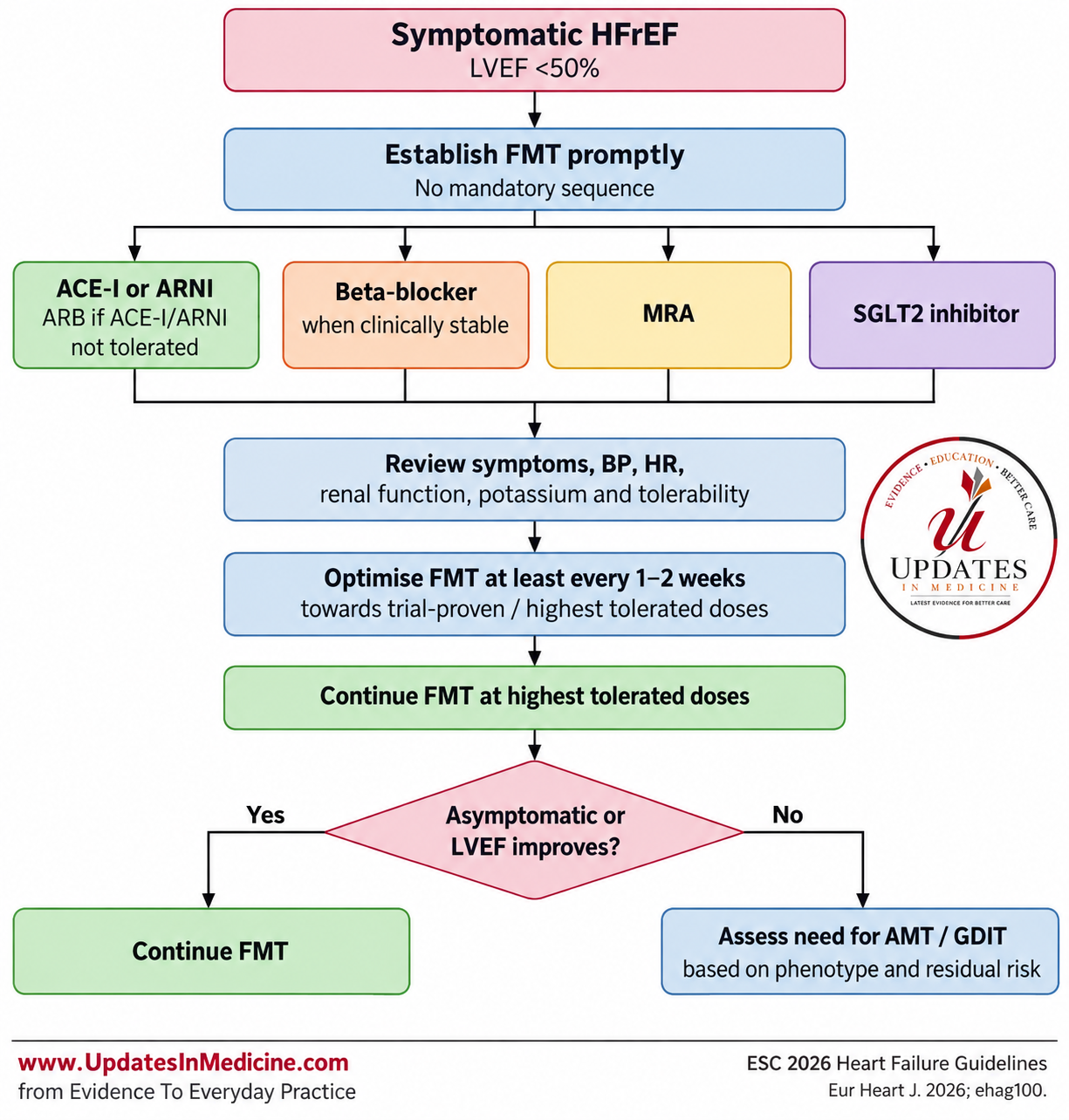
Plain-language equivalent: Once symptomatic HFrEF is diagnosed, establish the four foundational classes without waiting for a rigid sequence. Treatment should be individualised according to blood pressure, heart rate, renal function, potassium and tolerability. During optimisation, FMT should be reviewed and uptitrated at least every 1–2 weeks towards trial-proven or highest tolerated doses. FMT should usually continue even when symptoms resolve or LVEF improves.
Source locator: Sections 6.1.2 and 6.1.4; Recommendation Table 5; Figure 3.
Caption: Editorial synthesis of ESC recommendations; there is no guideline-mandated sequence for the four HFrEF foundational therapies.
An important limitation applies to the expanded HFrEF range: no large prospective RCT has exclusively evaluated beta-blockers or ACE-I/ARNI/ARB in patients with LVEF 41%–49%, although available evidence suggests treatment response resembles that of patients with lower LVEF.
Should FMT continue when LVEF improves?
Yes, in most patients.
Continuation of FMT at the highest tolerated doses is recommended in all patients with HF, including those who become asymptomatic or whose LVEF improves (Class I, Level C).
Gradual withdrawal may be considered only in highly selected patients after treatment of a reversible cause, with complete normalisation of LV function and volume and natriuretic peptides, together with frequent clinical, laboratory and imaging surveillance (Class IIb, Level C).
How should HFpEF be treated?
HFpEF now has explicit foundational pharmacological therapy.
Both SGLT2 inhibitors and MRAs are Class I foundational therapies for symptomatic HFpEF. The MRA evidence in HFpEF comes from trials involving both steroidal and non-steroidal MRAs, including spironolactone and finerenone.
Figure 2. Practical FMT pathway for HFpEF
Scope: symptomatic HFpEF with LVEF ≥50% and objective evidence supporting the diagnosis.
Symptomatic HFpEF
LVEF ≥50% + objective cardiac abnormalityStart foundational medical therapy
SGLT2 inhibitor
MRA
Assess symptoms, BP, renal function, potassium and volume status
Congestion present?
Yes
- Use dynamic individualised loop-diuretic dosing
No
- Continue FMT
Review during optimisation
Continue highest tolerated FMTPersistent symptoms / HF hospitalisation risk?
Yes
- ACE-I / ARB / ARNI may be considered to reduce HF hospitalisation
No
- Continue phenotype- and comorbidity-directed care
Plain-language equivalent: In symptomatic HFpEF, establish an SGLT2 inhibitor and MRA as foundational therapy. Treat congestion with individualised loop-diuretic dosing. Reassess renal function, potassium, blood pressure and symptoms during optimisation. ACE-I, ARB or ARNI may be considered in selected symptomatic patients to reduce HF hospitalisation, but these therapies are additional rather than foundational therapy in HFpEF.
Source locator: Sections 6.1.2 and 6.1; Recommendation Table 5.
Caption: Editorial synthesis of ESC HFpEF pharmacological recommendations.
ACE-I, ARB or ARNI may be considered in symptomatic HFpEF to reduce HF hospitalisation (Class IIb, Level C).
What additional therapy may be considered in HFrEF?
Additional medical therapy depends on phenotype and residual risk.
Examples include:
- Ivabradine in selected symptomatic HFrEF with LVEF ≤35%, sinus rhythm and resting heart rate >70 bpm despite maximally tolerated foundational therapy.
- Cardiac glycosides in selected symptomatic HFrEF with LVEF ≤40% despite optimal FMT.
- Hydralazine–isosorbide dinitrate in defined populations.
- Vericiguat in selected symptomatic HFrEF with LVEF <45% despite optimal FMT.
These therapies should not be regarded as interchangeable with FMT; their recommendations apply to specific subgroups.
When should ICD or CRT be considered?
Device therapy remains integrated with medical treatment.
| Clinical setting | Recommendation |
|---|---|
| Ischaemic HFrEF, NYHA II–III, LVEF ≤35% despite ≥3 months optimal FMT | ICD recommended |
| Non-ischaemic HFrEF, NYHA II–III, LVEF ≤35% despite ≥3 months optimal FMT | ICD should be considered |
| Within 40 days after MI | Primary-prevention ICD not recommended |
| HFrEF, LVEF ≤35%, sinus rhythm, LBBB, QRS ≥150 ms despite optimal FMT | CRT recommended |
The guideline also allows FMT initiation and CRT planning to occur simultaneously in selected symptomatic HFrEF patients with LBBB, QRS ≥150 ms and LVEF ≤35%, although LVEF should be reassessed before implantation.
How should decompensated HF be managed?
Decompensated HF remains a major part of the guideline, although its detailed management pathway is addressed separately.
The immediate priorities are to identify congestion, respiratory failure, hypoperfusion or cardiogenic shock, while treating the precipitating cause.
For congestion, IV loop diuretics remain the cornerstone. Response should be assessed early, and patients with inadequate diuresis may require loop-diuretic escalation and short-term sequential nephron blockade.
For respiratory compromise:
- oxygen is recommended when SpO₂ <90% or PaO₂ <60 mmHg;
- non-invasive ventilation should be considered for significant respiratory distress;
- intubation is recommended for progressive respiratory failure despite oxygen/NIV.
After initial stabilisation, in-hospital SGLT2-I initiation is recommended to improve symptoms and reduce HF hospitalisation.
Haemodynamic therapies are conditional. IV vasodilators may be considered when systolic BP is >110 mmHg; inotropes may be considered with systolic BP <90 mmHg plus hypoperfusion despite standard therapy; norepinephrine is the preferred vasopressor option when vasopressor support is required in cardiogenic shock.
The admission should also be used to optimise long-term HF therapy and ensure residual congestion is addressed before discharge.
When should advanced heart failure be suspected?
Advanced HF should be considered before repeated admissions and progressive organ dysfunction remove therapeutic options.
Features that should prompt concern include recurrent HF hospitalisation, escalating diuretic requirements, diuretic resistance, intolerance of prognostic therapy, severe persistent symptoms, low blood pressure, worsening kidney or liver function, recurrent ICD shocks and severely impaired LV or RV function.
Early referral allows assessment for durable mechanical circulatory support, transplantation or advanced supportive care.
Heart transplantation is recommended in selected patients with advanced HF refractory to appropriate FMT and GDIT and without contraindications.
Which structural and coronary interventions matter?
Medical therapy and structural intervention should be considered together.
For symptomatic HFrEF with persistent severe secondary mitral regurgitation despite optimised FMT and CRT when indicated, mitral transcatheter edge-to-edge repair (TEER) is recommended when clinical and echocardiographic selection criteria are met. These include LVEF 20%–50%, LV end-systolic diameter ≤70 mm and absence of several adverse features such as severe RV dysfunction or advanced HF.
For obstructive coronary artery disease and persistent angina despite HF and antianginal treatment, coronary revascularisation is recommended for symptom relief. If revascularisation is planned in selected HFrEF patients with LVEF ≤35% and suitable multivessel disease, CABG should be considered as the preferred strategy for long-term survival.
Which comorbidities have specific treatment recommendations?
Comorbidities are treated as active therapeutic targets.
| Clinical issue | Guideline recommendation |
|---|---|
| Symptomatic HF, LVEF ≥45%, BMI ≥30 kg/m² | Semaglutide or tirzepatide should be considered |
| HF, BMI ≥35 kg/m² despite structured lifestyle + medication | Bariatric surgery may be considered |
| Symptomatic HFrEF with iron deficiency | IV iron recommended for symptoms/QoL |
| NSAIDs or COX-2 inhibitors | Not recommended because of HF worsening/HFH |
| ATTR cardiac amyloidosis, NYHA I–III | Tafamidis, acoramidis or vutrisiran recommended in eligible patients |
The obesity recommendation is specifically restricted to symptomatic HF with LVEF ≥45% and BMI ≥30 kg/m² and should not automatically be extrapolated to all HFrEF.
What role do multidisciplinary care and rehabilitation play?
Multidisciplinary care is a formal part of guideline-directed management.
Personalised exercise training within multidisciplinary cardiac rehabilitation is recommended in stable HF to improve exercise capacity and quality of life and reduce all-cause hospitalisation. Long-term exercise outside formal rehabilitation is also recommended where appropriate.
Patients with stable HF still require regular follow-up to reassess:
- symptom severity;
- medication adherence;
- rhythm and ECG changes;
- kidney function and electrolytes;
- iron status and other relevant laboratory parameters;
- need for repeat imaging or treatment adjustment.
Remote pulmonary artery pressure monitoring should be considered in selected symptomatic NYHA III patients with a recent HF hospitalisation.
What special situations should clinicians remember?
Pregnancy requires a distinct treatment approach.
Pre-conception counselling is recommended in patients with HF. During pregnancy, ACE inhibitors, ARBs, ARNIs, MRAs, ivabradine and SGLT2 inhibitors are not recommended because of foetotoxicity or teratogenicity.
In pregnant women with HFrEF, non-selective beta-blockers should be changed to beta1-selective agents such as metoprolol or bisoprolol with close maternal and fetal monitoring.
The guideline also provides disease-specific pathways for conditions including cardiac amyloidosis, myocarditis and adult congenital heart disease.
Clinical takeaway
The 2026 ESC guideline reframes HF management around stage, phenotype and trajectory. For chronic symptomatic HF, the central practical distinction is clear: HFrEF requires four foundational treatment classes, while HFpEF has two foundational classes—MRA and SGLT2 inhibition—with additional therapy selected according to phenotype, symptoms and comorbidities.
Across the entire guideline, the same clinical principle recurs: diagnose precisely, establish effective therapy early, reassess rather than wait, and escalate to devices, interventions or advanced-HF care when the patient’s trajectory demands it.
Full reference
Køber L, Adamo M, Ruwald A-C, Tomasoni D, Anderson LJ, Andersson C, Brugts JJ, et al. 2026 ESC Guidelines for the management of heart failure. Developed by the Task Force for the Management of Heart Failure of the European Society of Cardiology (ESC), with the special contribution of the Heart Failure Association (HFA) of the ESC; endorsed by the European Association for Cardio-Thoracic Surgery (EACTS). European Heart Journal. 2026. doi:10.1093/eurheartj/ehag100 .