
Introduction
The WHO guidelines for malaria are consolidated, evidence-based recommendations covering prevention, diagnosis, treatment, elimination and prevention of re-establishment. Their primary audience is ministries of health and national malaria programmes, although WHO explicitly identifies healthcare practitioners among the intended users. The guideline covers case management across age groups and clinical situations, including children and pregnant women.
This article focuses on diagnosis and clinical management. That distinction matters because several recommendations depend on local transmission intensity, drug susceptibility and national policy. The WHO document should therefore inform, rather than replace, locally adapted treatment protocols.
The source is a living consolidated guideline hosted on MAGICapp. The supplied PDF is the version dated 10 September 2026; WHO cautions that downloaded PDFs may subsequently become outdated if the online guideline is revised.
When should malaria be suspected?
Malaria has no uniquely diagnostic clinical presentation. WHO states that signs and symptoms are non-specific and that no combination reliably distinguishes malaria from other febrile illnesses.
In malaria-endemic areas, malaria should be suspected in a patient with fever ≥37.5°C or a history of fever without another obvious cause. In very low-incidence settings, the exposure history becomes particularly important: recent travel to a malaria-endemic area without protective measures is one example of an exposure that should prompt testing in a febrile patient.
| Clinical setting | When to suspect malaria | Practical next step |
|---|---|---|
| Malaria-endemic area | Fever ≥37.5°C or history of fever with no obvious alternative cause | Perform parasitological testing |
| Stable/high seasonal transmission | As above; in children, palmar pallor or haemoglobin <8 g/dL may also raise suspicion | Perform parasitological testing |
| Very low-incidence setting | Fever/history of fever plus plausible malaria exposure | Test patients with compatible epidemiological risk |
| Suspected severe malaria | Clinical features compatible with severe disease | Obtain testing, but do not delay treatment if diagnosis is delayed |
Source: WHO section 5.1, PDF pp. 166–168.
How should malaria be confirmed?
WHO's good practice statement is straightforward: all suspected cases should undergo parasitological testing by microscopy or RDT, with both methods supported by quality assurance. Results should ideally be available within 2 hours of presentation.
Microscopy and RDTs are complementary rather than identical tests.
Microscopy can identify the infecting species and quantify parasite density. This becomes particularly important when hyperparasitaemia is suspected, when treatment response needs monitoring, or when species identification will affect subsequent management.
RDTs detect parasite-specific antigens from a finger-prick blood sample. They are relatively simple to perform, require no electricity or specialist equipment and are particularly useful where quality-assured microscopy is not readily available. Where P. vivax is common and microscopy is unavailable, WHO advises use of a combination RDT that can detect P. vivax or pan-malarial antigens.
Current nucleic-acid amplification methods, including polymerase chain reaction, do not have a routine role in clinical malaria management in this guideline.
Figure 1. Initial diagnostic and treatment pathway for suspected malaria
This algorithm is an editorial synthesis of WHO sections 5.1, 5.2.1 and 5.2.2 and is intended for patients presenting with suspected symptomatic malaria.
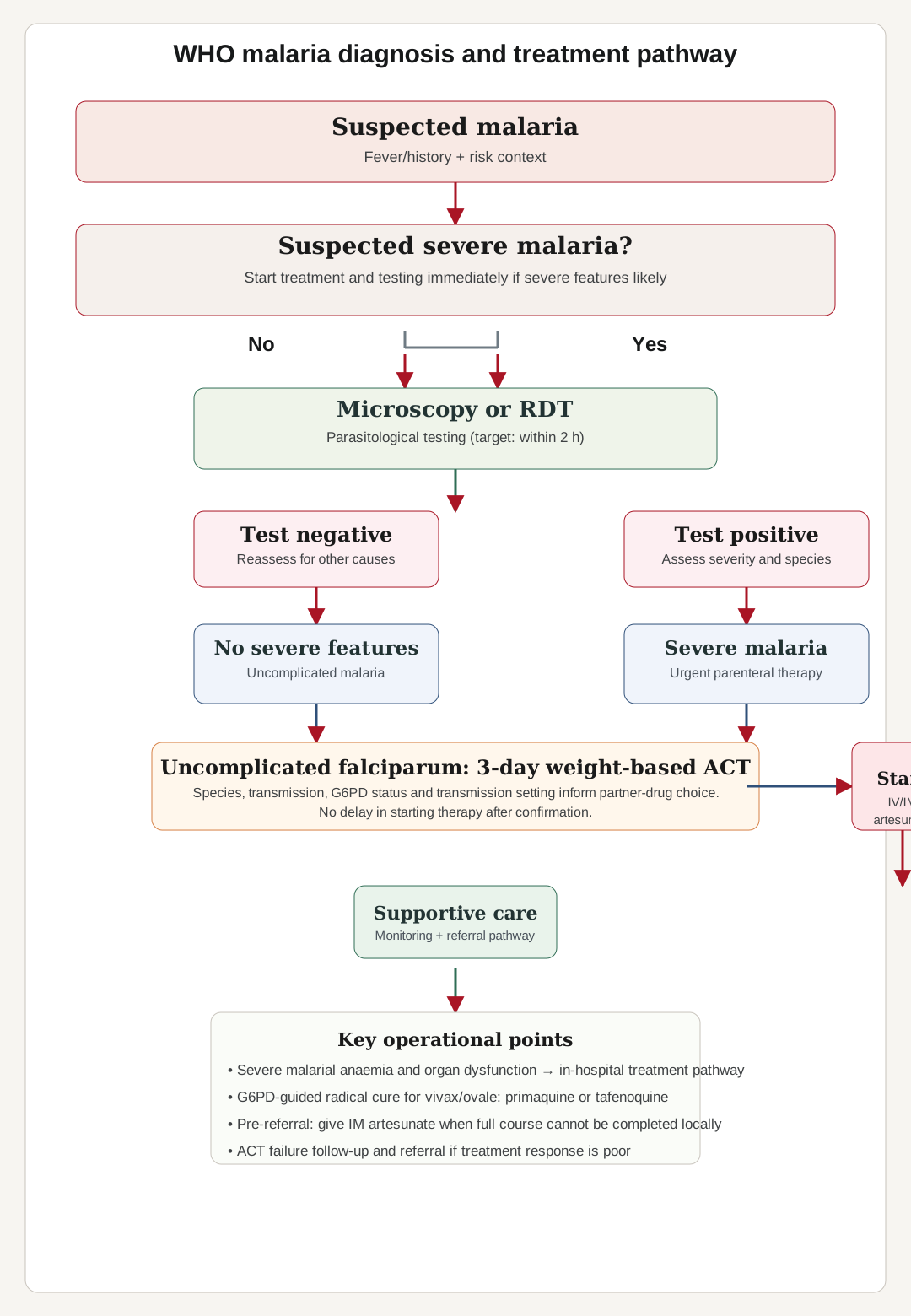
The flow is designed so treatment begins promptly when severe disease is possible and severity is assessed before definitive oral treatment choice. Positive testing is followed by severity and species-informed treatment decisions. Severe disease should receive parenteral therapy.
Plain-language equivalent: A patient with suspected malaria should normally undergo microscopy or RDT. If severe malaria is suspected, treatment and supportive care should begin immediately rather than waiting for delayed confirmation. A positive test is followed by severity assessment and species identification where possible. Severe malaria is treated with parenteral artesunate; uncomplicated disease receives the appropriate oral regimen. A negative test should trigger reassessment for another cause of fever. When severe malaria remains strongly suspected despite a negative initial blood film, WHO advises repeat films at 6–12-hour intervals or an RDT; if microscopy and RDT are both negative, malaria is unlikely.
Source locator: Sections 5.1, 5.2.1 and 5.2.2; PDF pp. 166–169 and 212–222.
How should severity be assessed?
A positive malaria test is not the end of the diagnostic process. The next clinical question is whether the patient has uncomplicated or severe malaria.
WHO defines uncomplicated malaria as symptomatic malaria with a positive parasitological test but without features of severe disease. Patients who cannot reliably take oral medication, have vital-organ dysfunction or have a high parasite burden require particular caution.
For severe falciparum malaria, WHO lists the following criteria:
| Finding | WHO severe-malaria criterion |
|---|---|
| Impaired consciousness | Glasgow Coma Scale <11 in adults or Blantyre Coma Score <3 in children |
| Prostration | Unable to sit, stand or walk without assistance |
| Multiple convulsions | >2 episodes in 24 hours |
| Acidosis | Base deficit >8 mEq/L, or bicarbonate <15 mmol/L, or venous lactate ≥5 mmol/L |
| Hypoglycaemia | Glucose <2.2 mmol/L (<40 mg/dL) |
| Severe malarial anaemia | Age-specific severe anaemia thresholds plus parasitaemia >10,000/µL |
| Renal impairment | Creatinine >265 µmol/L (3 mg/dL) or blood urea >20 mmol/L |
| Jaundice | Bilirubin >50 µmol/L (3 mg/dL) plus parasitaemia >100,000/µL |
| Pulmonary oedema | Radiological confirmation or specified hypoxaemia/respiratory criteria |
| Significant bleeding | Recurrent/prolonged bleeding, haematemesis or melaena |
| Shock | WHO compensated or decompensated shock criteria |
| Hyperparasitaemia | P. falciparum parasitaemia >10% |
Severe P. vivax is assessed using the same organ-dysfunction framework but without parasite-density thresholds. P. knowlesi has separate density thresholds specified by WHO.
How should uncomplicated P. falciparum malaria be treated?
WHO gives a strong recommendation with high-certainty evidence for treating adults and children with uncomplicated P. falciparum malaria using an ACT.
Recommended ACT options are:
- artemether–lumefantrine
- artesunate–amodiaquine
- artesunate–mefloquine
- dihydroartemisinin–piperaquine
- artesunate plus sulfadoxine–pyrimethamine
- artesunate–pyronaridine.
ACT regimens should contain 3 days of an artemisinin derivative, also a strong recommendation supported by high-certainty evidence. WHO emphasises weight-based dosing, full treatment courses and combination therapy with effective drugs that have different mechanisms of action. Fixed-dose ACT formulations are preferred where readily available.
Choice among ACTs is not simply interchangeable prescribing. National recommendations should reflect efficacy, adherence and local resistance patterns.
First-trimester pregnancy
WHO strongly recommends artemether–lumefantrine for uncomplicated P. falciparum malaria in the first trimester, based on low-certainty evidence.
Evidence for routine use of several other ACTs in the first trimester remains insufficient. Artesunate plus sulfadoxine–pyrimethamine is contraindicated because antifolates are contraindicated in the first trimester; WHO also notes no documented first-trimester experience with artesunate–pyronaridine.
Infants weighing <5 kg
This is an explicitly updated 2026 recommendation.
Infants weighing <5 kg with uncomplicated P. falciparum malaria should receive an ACT at the same mg/kg target dose as children weighing 5 kg. Where artemether–lumefantrine is available, WHO states that the newer 1:12 artemether:lumefantrine formulation intended for babies <5 kg should be used. This recommendation was not evaluated using the GRADE framework.
Hyperparasitaemia
WHO defines uncomplicated hyperparasitaemia as ≥4% parasitaemia without severe features. These patients have increased risks of treatment failure and progression to severe disease.
Patients with 4–10% parasitaemia require close monitoring and, if feasible, hospital admission. Parasitaemia >10% constitutes severe malaria in all settings. In non-immune patients and low-transmission settings, >2% parasitaemia already warrants close attention. Importantly, accurate quantitative microscopy is needed: RDTs cannot quantify this risk.
When should single-dose primaquine be added?
The 2026 guideline contains an explicit update on reducing transmissibility of treated P. falciparum infections.
In low-transmission areas, WHO gives a strong recommendation based on very-low-certainty evidence to add a single 0.25 mg/kg dose of primaquine to an ACT to reduce transmission.
For this low single dose, G6PD testing is not required.
It should not be given to pregnant women, infants aged <1 month or women breastfeeding infants aged <1 month. The recommendation should not be extrapolated to moderate-to-high transmission settings, including areas with antimalarial resistance.
How is non-falciparum malaria treated?
For uncomplicated P. vivax, P. ovale, P. malariae or P. knowlesi:
| Situation | Recommended blood-stage treatment |
|---|---|
| Chloroquine-susceptible infection | ACT or chloroquine |
| Chloroquine-resistant infection | ACT |
| Species uncertain | Treat as uncomplicated P. falciparum |
| Mixed malaria infection | ACT is the treatment of choice |
The major additional issue for P. vivax and P. ovale is relapse. These species can form dormant hepatic hypnozoites, so successful blood-stage treatment does not by itself achieve radical cure.
How should G6PD status guide radical cure?
WHO recommends using G6PD status to guide primaquine or tafenoquine use.
Semi-quantitative testing separates patients into broadly relevant activity categories: <30%, 30–70%, and ≥70% of normal activity. Qualitative tests can identify activity below approximately 30%, but cannot reliably identify heterozygous females with intermediate activity.
For eligible patients with uncomplicated P. vivax or P. ovale, WHO strongly recommends a primaquine total dose of 7 mg/kg, delivered as either 0.5 mg/kg/day for 14 days or 1 mg/kg/day for 7 days. The 1 mg/kg/day 7-day regimen should be used only when G6PD activity is ≥70%. The guideline notes geographical variation in absolute benefit: in parts of the Indian subcontinent and the Americas, a lower total dose of 3.5 mg/kg may be used where the incremental benefit of 7 mg/kg is small.
Tafenoquine receives a conditional recommendation based on low-certainty evidence as an alternative to low-total-dose primaquine in selected P. vivax patients aged ≥2 years who have ≥70% G6PD activity and are receiving chloroquine. This recommendation currently pertains only to South America. Quantitative or semi-quantitative G6PD testing is mandatory, and tafenoquine is not recommended in pregnant or lactating women or in patients receiving an ACT for P. vivax.
How should severe malaria be treated?
Severe malaria is a medical emergency. WHO states that a severely ill patient requires immediate supportive care and that parenteral antimalarial treatment should begin without delay when severe malaria is possible.
WHO gives a strong recommendation with high-certainty evidence for intravenous or intramuscular artesunate in adults and children with severe malaria, including infants, pregnant women in all trimesters and lactating women.
Parenteral therapy should continue for at least 24 hours, and until the patient can tolerate oral medication. Treatment must then be completed with a full 3-day ACT.
Children weighing <20 kg should receive artesunate 3 mg/kg per dose, compared with 2.4 mg/kg per dose for larger children and adults. This recommendation is based on pharmacokinetic modelling rather than GRADE evaluation.
Alongside antimalarial therapy, severe malaria requires close supportive management. WHO emphasizes monitoring of vital signs, coma score, urine output and blood glucose; parasite count, haematocrit and glucose can often be assessed immediately. Blood glucose should be monitored frequently, particularly in unconscious patients.
Hyperparasitaemic non-immune patients treated with artesunate also require follow-up because delayed haemolysis may begin more than one week after treatment.
What should be given before referral?
When complete treatment for severe malaria cannot be provided locally but injection is available, WHO strongly recommends a single intramuscular dose of artesunate followed by referral.
If intramuscular artesunate is unavailable, intramuscular artemether should be used; if that is also unavailable, intramuscular quinine is an option.
When injectable artesunate is unavailable in a child <6 years, give a single rectal dose of artesunate 10 mg/kg and refer immediately. Rectal artesunate should not be used in older children or adults.
What if treatment appears to have failed?
Before labelling an ACT failure, ask about vomiting, adherence, dosing, medicine quality and antimalarial treatment within the previous 1–2 months.
Recurrence or persistence within 28 days should, where possible, be parasitologically confirmed and treated with an alternative ACT known to be effective locally.
Recurrence after 4 weeks may represent either recrudescence or reinfection. Because polymerase chain reaction genotyping is not routinely available for clinical care, WHO advises treating presumed failures after 4 weeks operationally as new infections with the first-line ACT, with specific caution against reusing mefloquine within 60 days.
At programme level, an antimalarial in national policy should be changed when total treatment failure reaches ≥10% on therapeutic efficacy monitoring. A newly introduced treatment should have an average clinical-trial cure rate >95%.
Clinical takeaway
The practical sequence is simple even though the details are not: suspect malaria from the clinical and exposure context, confirm it parasitologically, assess severity immediately, and let species, parasite burden, transmission setting and patient characteristics determine treatment. Severe disease demands artesunate and supportive care without delay; P. vivax and P. ovale require a separate radical-cure decision guided by G6PD status.
Full reference
World Health Organization. WHO guidelines for malaria, 10 September 2026. Geneva: World Health Organization; 2026. DOI: 10.2471/B09879. Licence: CC BY-NC-SA 3.0 IGO.