
2026 ATS Clinical Practice Guideline in Practice
Acute respiratory failure requires more than selecting an oxygen-delivery device. The clinician must first decide whether noninvasive support is appropriate, identify whether the dominant problem is hypoxaemia or ventilatory failure, and establish clear criteria for escalation.
The 2026 American Thoracic Society guideline addresses:
- De novo acute hypoxaemic respiratory failure
- Acute hypercapnic respiratory failure
- Preoxygenation before intubation
- Respiratory support after extubation
The central message is that noninvasive respiratory support should be treated as a closely monitored therapeutic trial—not as a reason to delay intubation.
First decide whether the patient needs intubation
Before selecting HFNO, NIV or CPAP, look for an immediate indication for invasive ventilation:
- Impending respiratory arrest
- Inability to protect the airway
- Severe haemodynamic instability
- Rapidly worsening gas exchange
- Progressive respiratory muscle fatigue
- Deteriorating consciousness
- Failure of appropriately delivered noninvasive support
A satisfactory oxygen saturation does not confirm treatment success if respiratory effort, acidaemia or physiological deterioration continues.
Bedside respiratory-support algorithm
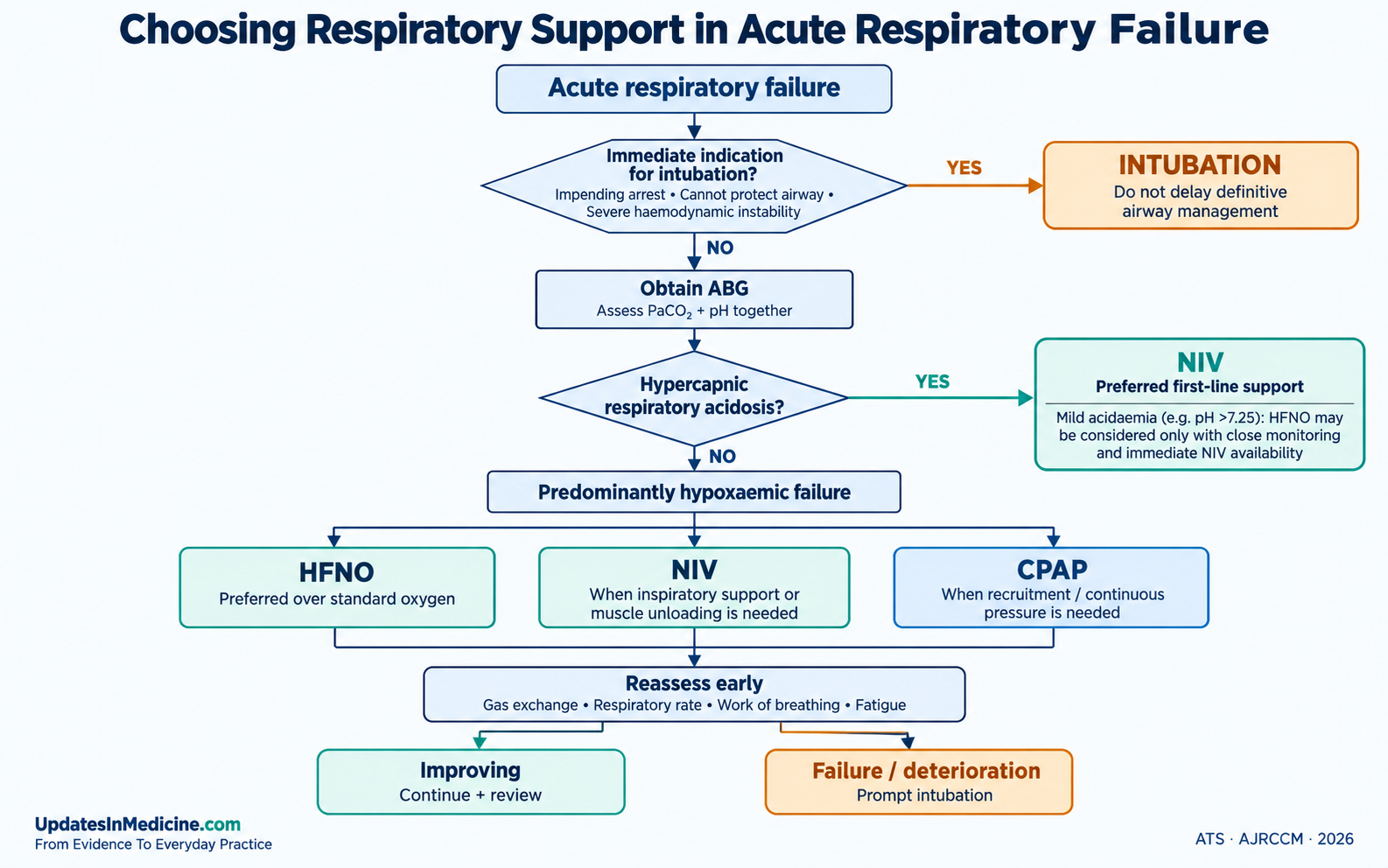
Step 1 — Is immediate intubation required?
Yes
→ Proceed to endotracheal intubation.
No
→ Obtain an arterial blood gas and identify the dominant physiological problem.
Step 2 — Is hypercapnic respiratory acidosis present?
Yes
→ Start NIV.
→ If acidaemia is mild, such as pH above 7.25, HFNO may be considered only when close monitoring and immediate escalation to NIV are available.
No
→ Follow the predominantly hypoxaemic pathway.
Step 3 — Predominantly hypoxaemic respiratory failure
→ Prefer HFNO over standard oxygen.
→ Consider NIV when inspiratory assistance or greater respiratory-muscle unloading is required.
→ Consider CPAP when the main requirement is continuous distending pressure and alveolar recruitment, with preserved spontaneous ventilation.
Step 4 — Reassess early
Improving
→ Continue support with repeated clinical review.
Worsening gas exchange, respiratory effort, acidaemia or fatigue
→ Escalate support and proceed promptly to intubation when indicated.
Predominantly hypoxaemic respiratory failure: HFNO becomes the preferred starting point
For adults with de novo acute hypoxaemic respiratory failure, the ATS strongly recommends HFNO rather than standard oxygen therapy.
HFNO provides:
- A high and relatively stable inspired oxygen concentration
- Heated and humidified gas
- Anatomical dead-space washout
- A modest positive airway pressure effect
- Improved comfort and secretion clearance
- Easier communication and oral care than a sealed mask
Compared with standard oxygen, HFNO reduced the need for intubation. This benefit supports the strong recommendation, although its effect on mortality remains less certain.
Who is an appropriate HFNO candidate?
HFNO is most appropriate when the patient has:
- Predominantly hypoxaemic respiratory failure
- Inadequate oxygenation with standard oxygen
- No significant hypercapnic respiratory acidosis
- Preserved airway protection
- Manageable secretions
- Relative haemodynamic stability
- Access to close observation and rapid escalation
When should HFNO not be the primary strategy?
HFNO should not replace NIV or intubation when there is:
- An immediate indication for intubation
- Clinically important hypercapnic respiratory acidosis
- Inability to protect the airway or manage secretions
- Severe haemodynamic instability
- Increasing oxygen requirements
- Persistent tachypnoea or respiratory distress
- Worsening fatigue, gas exchange or consciousness
HFNO has relatively few absolute contraindications. The greater danger is selecting the wrong patient or allowing an improved oxygen saturation to delay escalation.
Hypercapnic respiratory failure: NIV remains first-line
For acute hypercapnic respiratory failure, the ATS strongly recommends facemask NIV over standard oxygen.
NIV provides inspiratory pressure support together with PEEP. This can:
- Reduce inspiratory effort
- Unload respiratory muscles
- Increase alveolar ventilation
- Reduce PaCO₂
- Correct respiratory acidosis
- Reduce intubation and mortality
Most evidence comes from patients with acute COPD exacerbations. Hypercapnic failure may also occur with obesity-related hypoventilation, neuromuscular disease, drug-induced hypoventilation, asthma or cardiogenic pulmonary oedema, but these groups were less well represented.
Does HFNO have a role in hypercapnia?
HFNO may be considered in carefully selected patients with mild hypercapnia and mild acidaemia, such as pH above 7.25.
This is a conditional option—not a replacement for NIV in more severe respiratory acidosis.
If HFNO is used:
- NIV must be immediately available.
- Clinical and blood-gas reassessment is essential.
- Escalation criteria should be defined before treatment begins.
- Failure to improve should prompt transition to NIV.
- Progressive or more severe acidaemia should be managed with NIV unless intubation is required.
Approximately one-third of patients initially managed with HFNO in the relevant studies required escalation to NIV.
NIV versus CPAP: understand the physiological difference
NIV and CPAP are not interchangeable.
NIV
NIV provides inspiratory pressure support plus PEEP. It is better suited to patients requiring assistance with ventilation or respiratory-muscle unloading.
Examples include:
- COPD exacerbation with respiratory acidosis
- Obesity-related hypoventilation
- Neuromuscular ventilatory failure
- Markedly increased work of breathing
CPAP
CPAP provides continuous distending pressure without additional inspiratory support. Its principal effects are alveolar recruitment and improved oxygenation.
Examples include:
- Acute cardiogenic pulmonary oedema
- Recruitable hypoxaemic respiratory failure
- Selected pneumonia or COVID-19-related hypoxaemia with preserved ventilation
For de novo acute hypoxaemic respiratory failure, NIV and CPAP are conditional options over standard oxygen. The supporting evidence is less certain than that for HFNO.
The guideline does not establish HFNO, NIV or CPAP as universally superior. Selection should reflect physiology, patient tolerance, staff expertise and available resources.
Cardiogenic pulmonary oedema was represented within the evidence but was not assessed as a dedicated clinical question. Its established physiological relationship with CPAP should therefore be considered separately.
Monitoring noninvasive respiratory support
Every noninvasive strategy requires planned reassessment. Monitoring should include:
- Respiratory rate and work of breathing
- Patient comfort and synchrony
- Oxygen requirement and delivered FiO₂
- Oxygen saturation and arterial oxygenation
- PaCO₂ and pH when ventilatory failure is possible
- Haemodynamic status
- Mental state and airway protection
- Secretion burden
- Interface tolerance and air leak
Warning signs of failure include:
- Persistent or worsening tachypnoea
- Increasing inspiratory effort
- Progressive fatigue
- Worsening hypoxaemia despite increasing support
- Rising PaCO₂ or worsening acidaemia
- Haemodynamic deterioration
- Deteriorating consciousness
- Inability to clear secretions
- Intolerance preventing effective support
These findings should trigger urgent senior review and preparation for intubation. Repeatedly changing noninvasive devices should not postpone definitive airway management.
Preoxygenation before intubation
For adults with acute respiratory failure undergoing endotracheal intubation, the ATS strongly recommends HFNO or facemask NIV rather than standard oxygen for preoxygenation.
Both strategies reduce peri-intubation hypoxaemia. NIV may provide greater alveolar recruitment, while HFNO is easier to apply and can remain in place during laryngoscopy.
The guideline does not recommend one modality over the other. Selection should consider:
- Severity and mechanism of hypoxaemia
- Current respiratory support
- Haemodynamic stability
- Mask tolerance
- Available equipment
- Staff experience
- Urgency of intubation
Preoxygenation must never delay an immediately necessary airway intervention.
Respiratory support after extubation
Following planned extubation after critical illness, prophylactic HFNO or NIV is suggested over standard oxygen.
The choice should be based primarily on the patient’s risk of extubation failure.
Higher-risk patients
Facemask NIV is preferred over HFNO or standard oxygen when risk factors include:
- Age 65 years or older
- Obesity
- Hypercapnia
- Moderate-to-severe cardiopulmonary disease
- APACHE II score of 12 or higher
- Prolonged mechanical ventilation
- Complex weaning
- Multiple comorbidities
- Weak cough or difficulty managing secretions
- Possible airway patency problems
- Severe underlying illness
Lower-risk patients
HFNO is a reasonable and often better-tolerated option in patients without major high-risk features.
Very-low-risk patients who are oxygenating well, have a good cough, minimal secretions, short-duration ventilation and no significant cardiopulmonary disease may be suitable for low-flow oxygen or room air.
These recommendations mainly concern prophylactic support immediately after planned extubation. They should not be interpreted as support for prolonged rescue HFNO when post-extubation respiratory failure is progressing. Delayed reintubation may be harmful.
Important areas of uncertainty
The guideline does not establish:
- A universally superior modality for acute hypoxaemic failure
- Superiority of HFNO over NIV or CPAP in direct comparisons
- A routine role for CPAP in hypercapnic respiratory failure
- Optimal HFNO flow settings for hypercapnic failure
- Safety of HFNO as a substitute for NIV in severe acidaemia
- A preferred HFNO-versus-NIV strategy for preoxygenation
- Clear benefit from routinely alternating HFNO and NIV
Practical clinical takeaways
- Decide whether intubation is required before selecting a noninvasive device.
- Use the ABG to distinguish predominantly hypoxaemic failure from hypercapnic respiratory acidosis.
- Prefer HFNO over standard oxygen for de novo acute hypoxaemic respiratory failure.
- Use NIV as first-line support for acute hypercapnic respiratory acidosis.
- Consider HFNO in hypercapnia only when acidaemia is mild and rapid NIV escalation is available.
- Use CPAP when continuous distending pressure is required without inspiratory assistance.
- Use HFNO or NIV rather than standard oxygen for preoxygenation before intubation.
- After extubation, select support according to the risk of extubation failure.
- Define monitoring and escalation criteria before starting treatment.
- Do not allow HFNO, NIV or CPAP to delay necessary intubation.
Evidence summary
| Clinical setting | Recommendation | Strength | Certainty |
|---|---|---|---|
| De novo acute hypoxaemic respiratory failure | HFNO rather than standard oxygen | Strong | Moderate |
| De novo acute hypoxaemic respiratory failure | NIV rather than standard oxygen | Conditional | Low |
| De novo acute hypoxaemic respiratory failure | CPAP rather than standard oxygen | Conditional | Low |
| Hypercapnic respiratory failure | Facemask NIV rather than standard oxygen | Strong | Moderate |
| Mild hypercapnia with mild acidaemia, such as pH >7.25 | HFNO may be used when monitoring and rapid NIV escalation are available | Conditional | Low |
| Preoxygenation before intubation | HFNO or facemask NIV rather than standard oxygen | Strong | Moderate |
| Planned extubation after critical illness | HFNO or NIV rather than standard oxygen | Conditional | Moderate |
| High risk of extubation failure | Facemask NIV rather than standard oxygen or HFNO | Conditional | Moderate |
Selected effect estimates
| Outcome | Comparison | Effect estimate |
|---|---|---|
| Intubation in acute hypoxaemic failure | HFNO vs standard oxygen | RR 0.76; 95% CI 0.64–0.89 |
| Peri-intubation hypoxaemia | NIV vs standard oxygen | RR 0.51; 95% CI 0.39–0.65 |
| Peri-intubation hypoxaemia | HFNO vs standard oxygen | RR 0.69; 95% CI 0.54–0.88 |
| Reintubation after planned extubation | NIV vs standard oxygen | RR 0.75; 95% CI 0.63–0.88 |
| Reintubation after planned extubation | HFNO vs standard oxygen | RR 0.80; 95% CI 0.64–1.00 |
Reference
Goel, N.N., Ferreyro, B.L., Pitre, T. et al. (2026) ‘Noninvasive respiratory support for adult patients with acute respiratory failure: an official American Thoracic Society Clinical Practice Guideline’, American Journal of Respiratory and Critical Care Medicine, 212(9), pp. 2135–2158. doi: 10.1093/ajrccm/aamag302.