
American College of Gastroenterology | Published 5 October 2026
Introduction
Cirrhosis is a major cause of morbidity, hospitalisation and mortality. However, early recognition and systematic preventive care can substantially alter its clinical course. Patients with compensated cirrhosis may maintain a favourable prognosis for years, while some patients with decompensated disease can achieve recompensation following effective treatment.
The 2026 American College of Gastroenterology (ACG) Clinical Guideline on Preventive Care for Patients With Cirrhosis provides 18 evidence-graded recommendations and six additional key concepts addressing four major areas:
- Prevention of cirrhosis-specific complications
- Prevention of infections
- Nutrition, exercise and lifestyle modification
- Prevention of non-liver-related complications
The guideline emphasises moving beyond reactive management of complications towards systematic prevention, early intervention and multidisciplinary long-term care.
1. Preventing Portal Hypertension and Variceal Bleeding
Carvedilol in compensated cirrhosis
Clinically significant portal hypertension (CSPH) is a major determinant of hepatic decompensation, particularly the development of ascites.
ACG suggests carvedilol in patients with compensated cirrhosis and CSPH to reduce the risk of first-onset ascites.
CSPH may be established by hepatic venous pressure gradient ≥10 mmHg or estimated using non-invasive investigations.
Non-invasive findings supporting a high probability of CSPH include:
- Liver stiffness ≥25 kPa.
- Liver stiffness greater than 20 kPa with platelet count below 150 × 10⁹/L.
These measurements should be interpreted in the appropriate clinical context.
Recommendation: Conditional | Evidence certainty: Low
Primary prevention of variceal bleeding
Patients with high-risk oesophageal varices should receive primary prophylaxis.
The guideline recommends either:
- Carvedilol, or
- Endoscopic variceal ligation (EVL)
High-risk varices include large varices and those with red wale markings.
Carvedilol provides additional alpha-1 adrenergic blockade, reducing portal pressure more effectively than traditional non-selective beta-blockers in many settings.
Practical carvedilol considerations
- Usual target dose: 12.5 mg daily, as a single or divided dose.
- A dose of 6.25 mg daily may be considered when the higher dose is not tolerated.
- Monitor tolerability, particularly hypotension and symptomatic bradycardia.
- Do not titrate carvedilol solely to achieve a target heart rate.
Both carvedilol and EVL are acceptable first-line strategies for high-risk varices. Treatment selection depends on tolerance, comorbidities and access to endoscopy.
Recommendation: Strong | Evidence certainty: Moderate
2. Preventing Hepatic Encephalopathy
Hepatic encephalopathy (HE) is associated with cognitive impairment, functional disability, recurrent hospitalisations and substantial caregiver burden.
The guideline distinguishes between preventing progression from minimal HE and preventing recurrence following overt HE.
Minimal hepatic encephalopathy
For patients with cirrhosis and minimal hepatic encephalopathy (MHE), ACG suggests lactulose rather than no treatment to reduce progression to overt HE.
In a randomised study, overt HE developed in 11% of patients receiving lactulose compared with 28% without treatment.
When lactulose is initiated to manage symptoms attributable to MHE, treatment adherence and symptomatic response should be reassessed after 4–8 weeks to determine whether treatment should continue.
Recommendation: Conditional | Evidence certainty: Low
Prevention of recurrent overt HE
For patients who develop overt HE despite receiving lactulose, ACG suggests adding rifaximin to lactulose.
The evidence is particularly relevant to patients hospitalised with overt HE while receiving lactulose. Combination therapy should generally be continued following discharge when indicated for prevention of recurrence.
Rifaximin is not recommended for primary prevention in MHE
Although rifaximin can improve psychometric performance in patients with MHE, evidence that it prevents progression to overt HE is insufficient.
Therefore, the guideline does not suggest routinely prescribing rifaximin solely for primary prevention of overt HE in patients with minimal HE.
Both rifaximin recommendations: Conditional | Evidence certainty: Low
3. Preventing Infections During Upper Gastrointestinal Bleeding
Patients with cirrhosis presenting with upper gastrointestinal bleeding are vulnerable to bacterial infections, rebleeding and clinical deterioration.
ACG suggests a short course of prophylactic antibiotics lasting 2–3 days, rather than a longer course or no prophylaxis.
This recommendation applies to upper gastrointestinal bleeding from either variceal or non-variceal sources, regardless of the presence of ascites.
Ceftriaxone and norfloxacin were among the antibiotics evaluated in the supporting studies.
Although shorter courses appear to preserve important survival benefits, some studies identified a higher incidence of bacterial infections compared with longer treatment.
Consequently, duration should be individualised, particularly for patients at increased infection risk. Local antimicrobial resistance patterns and clinical severity remain important considerations.
Recommendation: Conditional | Evidence certainty: Low
4. Preventing Complications Following Paracentesis
Large-volume paracentesis can cause circulatory dysfunction, hyponatraemia and acute kidney injury.
The guideline advises intravenous albumin replacement when more than 5 litres of ascitic fluid are removed.
Recommended albumin replacement
6–8 g of intravenous albumin per litre of ascitic fluid removed.
For example, removal of 6 litres would require approximately 36–48 g of albumin.
For paracentesis involving 5 litres or less, routine albumin administration has less certain benefits.
However, albumin may be appropriate in selected patients with:
- Hyponatraemia
- Evidence of renal dysfunction
- Increased risk of circulatory compromise
ACG key concept – not formally GRADE-assessed.
5. Hepatocellular Carcinoma Surveillance
Hepatocellular carcinoma (HCC) remains a major cause of liver-related mortality among patients with cirrhosis.
The guideline strongly recommends surveillance in patients with cirrhosis who are eligible for HCC-directed treatment.
Recommended surveillance strategy
Liver ultrasound + alpha-fetoprotein (AFP) every 6 months.
Surveillance should be considered in appropriate patients with cirrhosis regardless of underlying aetiology.
Potential candidates generally include:
- Patients with Child–Pugh A or B cirrhosis.
- Patients with Child–Pugh C cirrhosis who are listed for liver transplantation.
- Patients fit for and willing to undergo potential HCC treatments.
A meta-analysis of observational studies associated surveillance with improved early-stage HCC detection, increased receipt of curative therapies and reduced mortality.
Recommendation: Strong | Evidence certainty: Low
Aspirin and statins for HCC prevention
Despite observational associations between certain medications and lower HCC incidence, the guideline does not support their initiation solely for HCC prevention.
Aspirin: Do not prescribe solely to prevent HCC in patients with cirrhosis. Evidence is uncertain, and bleeding risk is an important concern.
Statins: Do not initiate solely for HCC chemoprevention. However, statins may still be appropriate in patients with compensated cirrhosis who have conventional cardiovascular indications.
6. Vaccination and Infection Prevention
Patients with cirrhosis may experience severe outcomes from otherwise preventable viral infections.
The 2026 ACG guideline places considerable emphasis on assessing immunisation status and ensuring appropriate vaccination.
Hepatitis A
Test for hepatitis A immunity and vaccinate patients without immunity.
Acute hepatitis A infection in an individual with underlying cirrhosis may precipitate acute hepatic deterioration or liver failure.
Strong recommendation | Low-certainty evidence
Hepatitis B
Assess hepatitis B immunity and vaccinate susceptible patients.
Vaccine responses may be reduced in cirrhosis. Patients who remain non-immune following previous vaccination should be considered for revaccination, potentially using an enhanced vaccination strategy or a newer TLR9-adjuvanted vaccine where available.
Conditional recommendation | Very-low-certainty evidence
Respiratory viral infections
The guideline recommends:
- Annual influenza vaccination.
- SARS-CoV-2 vaccination, with consideration of appropriate boosters.
- Bivalent respiratory syncytial virus (RSV) vaccination in patients aged 50 years or older.
Influenza, COVID-19 and RSV recommendations are strong, although the available evidence was graded as low certainty.
The ACG recommendations should be implemented alongside applicable national immunisation policies, vaccine availability and individual eligibility criteria.
7. Nutrition and Prevention of Sarcopenia
Malnutrition, sarcopenia and physical frailty are common in cirrhosis and are associated with adverse clinical outcomes.
The guideline recommends a proactive, dietitian-guided approach to nutritional management.
Recommended nutritional targets
| Parameter | Target |
|---|---|
| Protein intake | 1.2–1.5 g/kg ideal body weight/day |
| General energy intake | 30–35 kcal/kg/day |
| Energy intake, BMI 30–40 kg/m² | 25–35 kcal/kg/day |
| Energy intake, BMI ≥40 kg/m² | 20–25 kcal/kg/day |
Individual nutritional requirements should be tailored to body composition, obesity, nutritional status and clinical condition.
Evidence indicates that structured nutritional interventions can improve frailty, functional status and, in some studies, hospitalisation outcomes.
Exercise is an essential partner to nutrition
For ambulatory patients with cirrhosis, ACG suggests structured programmes combining:
- Aerobic exercise
- Resistance training
- Functional and balance training where appropriate
Exercise programmes should be individualised according to functional capacity and monitored for safety.
The most consistent improvements in muscle health have been observed when nutritional support and exercise are combined.
Nutrition and exercise: Conditional recommendations | Low-certainty evidence
8. Alcohol Use Disorder and Smoking Cessation
Alcohol use disorder
Alcohol consumption can accelerate disease progression and precipitate further decompensation.
ACG highlights systematic screening for alcohol use disorder (AUD), preferably using a validated instrument such as AUDIT-C.
Screening should be undertaken at clinical encounters, particularly following clinical deterioration or hepatic decompensation.
For patients with cirrhosis and AUD who are hospitalised, the guideline suggests arranging postdischarge behavioural therapy to reduce alcohol consumption.
Pharmacological treatment may also be beneficial. The guideline discusses naltrexone and acamprosate among the options with supporting evidence. Medication selection requires assessment of the patient's hepatic function, other contraindications and the need for specialist input.
Integrated hepatology and addiction services can support sustained treatment engagement.
Postdischarge behavioural therapy: Conditional recommendation | Very-low-certainty evidence
Smoking cessation
Smoking is associated with accelerated liver fibrosis, increased liver cancer risk and higher mortality.
ACG strongly recommends smoking-cessation counselling for all active smokers with cirrhosis.
This intervention should be incorporated into routine hepatology care.
Strong recommendation | Low-certainty evidence
9. Osteoporosis and Fracture Prevention
Cirrhosis is associated with increased osteoporosis and fracture risk, yet bone-health screening and treatment remain underutilised.
Clinicians should consider bone mineral density assessment using dual-energy X-ray absorptiometry (DEXA) and initiate appropriate treatment when osteoporosis is identified.
ACG suggests bisphosphonate therapy for patients with cirrhosis and osteoporosis to reduce fractures.
Importantly, the presence of oesophageal or gastric varices is not, by itself, a contraindication to oral bisphosphonates.
Other established osteoporosis therapies may be considered according to standard treatment indications and individual patient factors.
Recommendation: Conditional | Evidence certainty: Low
10. Postdischarge Care and Extrahepatic Cancer Screening
Early postdischarge review
Recurrent hospitalisation is common in patients with decompensated cirrhosis.
The guideline highlights the potential benefits of enhanced discharge planning and outpatient follow-up within 14 days of hospital discharge.
A structured discharge programme may include medication reconciliation, nutritional assessment, management of AUD, physical rehabilitation and monitoring for recurrent complications.
Extrahepatic cancer screening
Patients with cirrhosis may also have an increased risk of malignancies outside the liver.
Age-appropriate screening should be considered in:
- Patients undergoing evaluation for or listed for liver transplantation.
- Patients with compensated cirrhosis who are non-frail and have no severe life-limiting comorbidities.
For patients with advanced decompensated cirrhosis who are not transplant candidates, the benefits of routine extrahepatic cancer screening are less certain.
Both are ACG key concepts rather than graded recommendations.
Practical Clinical Algorithms
Algorithm 1. Portal Hypertension and Prevention of First Decompensation
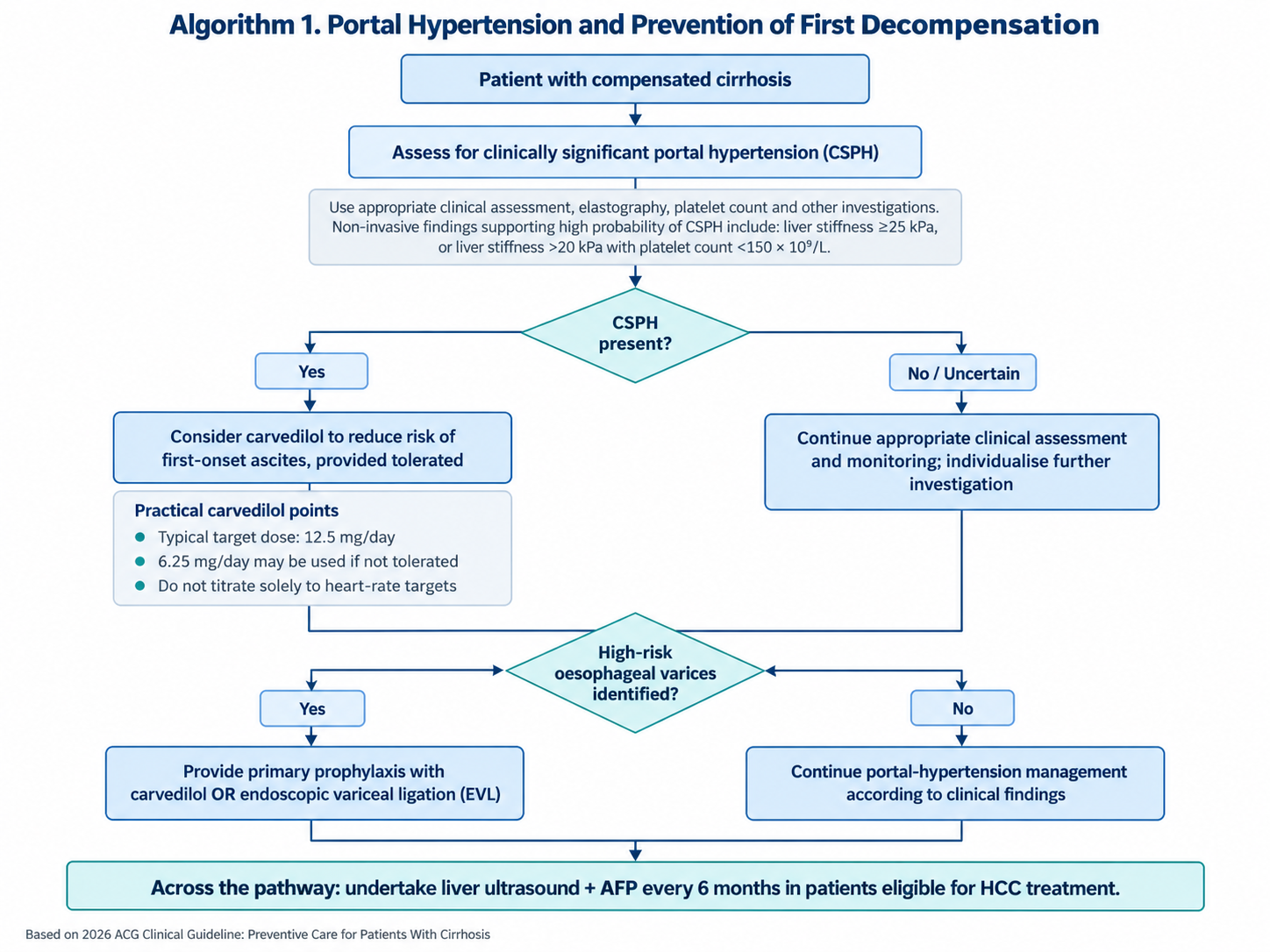
Patient with compensated cirrhosis
↓
Assess clinically significant portal hypertension (CSPH)
Use appropriate clinical assessment, elastography, platelet count and other investigations.
↓
CSPH present?
- Yes: Consider carvedilol to reduce the risk of first-onset ascites, provided it is tolerated.
- No or uncertain: Continue appropriate clinical assessment and monitoring; individualise further investigation.
↓
High-risk oesophageal varices identified?
- Yes: Provide primary prophylaxis with carvedilol OR EVL.
- No: Continue portal-hypertension management according to clinical findings.
Across the pathway: Undertake six-monthly ultrasound and AFP surveillance in patients eligible for HCC treatment.
Algorithm 2. Preventing Hepatic Encephalopathy
Patient with cirrhosis
↓
Determine HE status
| Clinical situation | Preventive strategy |
|---|---|
| Minimal HE without previous overt HE | Consider lactulose; reassess response after 4–8 weeks |
| Minimal HE without overt HE | Do not routinely use rifaximin solely for primary prevention |
| Overt HE occurring despite lactulose | Add rifaximin to lactulose to reduce recurrence |
| Following hospitalisation for overt HE on lactulose | Continue indicated combination therapy and arrange follow-up |
These pathways reflect the preventive recommendations in the ACG document and are not intended to replace the full assessment and management of acute decompensation.
Summary of the 18 ACG Recommendations
The guideline includes one moderate-certainty recommendation, 14 low-certainty recommendations and three very-low-certainty recommendations.
| No. | Recommendation | Strength | Evidence |
|---|---|---|---|
| 1 | Lactulose for minimal HE | Conditional | Low |
| 2 | Add rifaximin after overt HE on lactulose | Conditional | Low |
| 3 | Do not use rifaximin for primary prevention in MHE | Conditional | Low |
| 4 | Carvedilol or EVL for high-risk varices | Strong | Moderate |
| 5 | Short-course antibiotics for upper GI bleeding | Conditional | Low |
| 6 | Carvedilol for compensated cirrhosis with CSPH | Conditional | Low |
| 7 | HCC surveillance with ultrasound and AFP every 6 months | Strong | Low |
| 8 | Do not prescribe aspirin solely for HCC prevention | Conditional | Very low |
| 9 | Postdischarge behavioural therapy for AUD | Conditional | Very low |
| 10 | Hepatitis A immunity assessment and vaccination | Strong | Low |
| 11 | Hepatitis B immunity assessment and vaccination | Conditional | Very low |
| 12 | Influenza vaccination | Strong | Low |
| 13 | SARS-CoV-2 vaccination | Strong | Low |
| 14 | RSV vaccination from age ≥50 years | Strong | Low |
| 15 | Dietitian-guided nutritional intervention | Conditional | Low |
| 16 | Structured aerobic and resistance exercise | Conditional | Low |
| 17 | Smoking-cessation counselling | Strong | Low |
| 18 | Bisphosphonate therapy for osteoporosis | Conditional | Low |
Six Additional ACG Key Concepts
These statements provide practical guidance but were not formally graded using GRADE.
| Area | Key concept |
|---|---|
| Ascites | Albumin 6–8 g/L of ascites removed when paracentesis exceeds 5 L |
| HCC prevention | Do not initiate statins solely for HCC prevention |
| Hospital readmissions | Intensified outpatient care, including follow-up within 14 days |
| Hepatitis B vaccination | Consider revaccination in previous non-responders |
| Alcohol use disorder | Regular AUD screening and consideration of pharmacotherapy |
| Extrahepatic cancer | Age-appropriate screening in suitable patients |
Translating the Guideline Into Everyday Practice
The ACG proposes a three-pillar implementation framework.
Education and dissemination: Ensure that hepatologists, gastroenterologists, primary care clinicians and other healthcare professionals understand the preventive recommendations.
Stakeholder engagement: Involve nurses, dietitians, pharmacists, rehabilitation professionals and clinical administrators in shared preventive-care pathways.
Practice integration: Embed vaccination checks, HCC surveillance reminders, nutritional assessments, osteoporosis screening and postdischarge review into routine clinical workflows.
A structured preventive-care checklist may help reduce missed opportunities for intervention, particularly in busy outpatient services.
Conclusion
The 2026 ACG guideline reinforces a fundamental principle: optimal cirrhosis management requires prevention as well as treatment of established complications.
Carvedilol-based portal hypertension management, timely HCC surveillance, appropriate vaccination, nutritional support, structured exercise and effective alcohol and smoking interventions represent important opportunities to improve long-term outcomes.
These strategies should be delivered through coordinated multidisciplinary care, supported by systematic clinical reviews and reliable follow-up arrangements.
Importantly, most recommendations are supported by low or very-low-certainty evidence. Their strength, clinical applicability and individual patient circumstances should therefore guide implementation rather than treating every intervention as equally certain or universally appropriate.
Original Guideline Reference
Tapper, E.B., Kardashian, A., Debes, J., Gripshover, J., Moon, A.M., Kim, J.J. and Lai, J.C. (2026). ACG Clinical Guideline: Preventive Care for Patients With Cirrhosis. American Journal of Gastroenterology. Published online 5 October 2026.