
The 2026 approach to LDL-C management is increasingly straightforward: assess cardiovascular risk, define an appropriate LDL-C goal, lower LDL-C sufficiently, and maintain that reduction over time.
The National Lipid Association’s LDL-C Management Simplified series translates contemporary dyslipidaemia guidance into a practical clinical framework. Its central message is clear:
Lower for longer is better.
The magnitude of ASCVD risk reduction is closely related to both the degree of LDL-C lowering and the duration for which lower LDL-C is maintained. LDL-C management should therefore move beyond simply prescribing a statin towards risk-based treatment goals and active treatment intensification when those goals are not reached.
1. Start With ASCVD Risk
Lifestyle optimisation remains foundational for everyone, but pharmacological LDL-C lowering should be considered particularly in patients with:
- Established clinical or severe subclinical ASCVD
- Severe hypercholesterolaemia, particularly LDL-C ≥190 mg/dL
- Diabetes mellitus
- HIV infection
- CKD stage 3 or 4
- Sufficient calculated ASCVD risk to justify treatment
For adults aged 30–79 years without established ASCVD, the contemporary PREVENT-ASCVD calculator can help estimate 10-year risk and guide treatment discussions.
PREVENT-ASCVD risk categories
| 10-year ASCVD risk | Category |
|---|---|
| <3% | Low |
| 3–<5% | Borderline |
| 5–<10% | Intermediate |
| ≥10% | High |
Risk estimation is only the beginning. Risk-enhancing factors, inherited risk and evidence of subclinical atherosclerosis may justify more intensive LDL-C lowering than the calculated percentage alone would suggest.
Algorithm 1 — Initial LDL-C Management
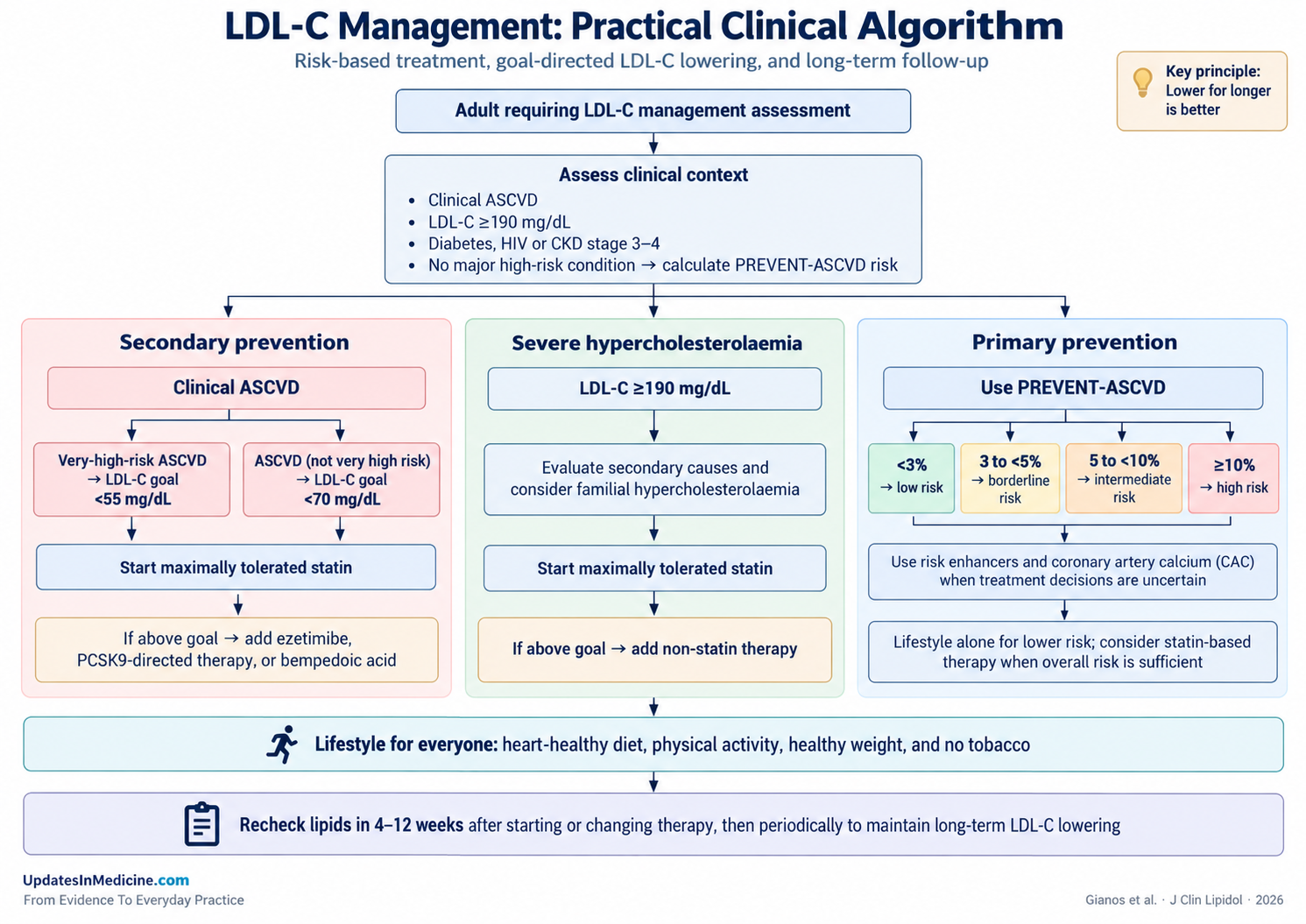
Adult requiring cardiovascular risk assessment
↓
Does the patient have clinical ASCVD?
YES → Secondary prevention → Define LDL-C goal according to ASCVD risk → Start/intensify maximally tolerated statin → Add non-statin therapy if goal is not reached
NO
↓
LDL-C ≥190 mg/dL?
YES → Evaluate secondary causes → Consider familial hypercholesterolaemia → Start maximally tolerated statin → Add non-statin therapy if needed
NO
↓
Diabetes, HIV or CKD stage 3–4?
YES → Statin-based therapy is generally appropriate according to age and individual risk
NO
↓
Calculate PREVENT-ASCVD risk
→ Low risk: lifestyle-focused management → Borderline/intermediate risk: assess risk enhancers ± CAC → High risk: consider pharmacological LDL-C lowering
2. Clinical ASCVD: Treat to an LDL-C Goal
A major shift in contemporary LDL-C management is the return to explicit treatment goals.
Secondary prevention LDL-C goals
| Clinical situation | LDL-C goal |
|---|---|
| Very-high-risk ASCVD | <55 mg/dL |
| ASCVD not classified as very high risk | <70 mg/dL |
The NLA authors additionally note that, given contemporary evidence supporting intensive LDL-C reduction, treating patients with clinical ASCVD towards <55 mg/dL may be reasonable when clinically appropriate.
The practical point is important: achieving an LDL-C reduction is not enough if the patient remains substantially above their risk-appropriate goal.
3. Primary Prevention: Personalise Treatment
Primary prevention should not rely on LDL-C concentration alone.
For patients without established ASCVD, treatment intensity should integrate:
- PREVENT-ASCVD risk
- Baseline LDL-C
- Diabetes
- CKD
- HIV
- Family history
- Risk-enhancing conditions
- Lp(a)
- Triglycerides
- ApoB where relevant
- Evidence of subclinical atherosclerosis
Important risk-enhancing features
Examples include:
- Premature ASCVD in a parent or sibling
- Higher-risk ancestry, including South Asian ancestry
- Chronic inflammatory disease
- Lp(a) ≥125 nmol/L or ≥50 mg/dL
- Persistent hypertriglyceridaemia
- hs-CRP ≥2 mg/L
- CKM syndrome
- Persistent LDL-C 160–189 mg/dL
- ApoB ≥120 mg/dL
- Pre-eclampsia
- Gestational diabetes or hypertension
- Premature menopause
These factors are particularly useful when the decision to start or intensify lipid-lowering therapy remains uncertain.
4. Use Coronary Artery Calcium When Risk Remains Uncertain
Coronary artery calcium scoring can help refine decisions in selected primary-prevention patients, particularly those at borderline or intermediate estimated risk.
The principle is straightforward:
Greater CAC burden → greater atherosclerotic burden → greater need for intensive LDL-C lowering.
A CAC score of zero may support deferring pharmacological treatment in carefully selected individuals without major high-risk features, while maintaining lifestyle intervention and reassessing risk later.
However, a zero CAC score should be interpreted cautiously in younger individuals or those with strong inherited risk because early non-calcified plaque may not yet be detected.
Algorithm 2 — Borderline or Intermediate Primary-Prevention Risk
PREVENT-ASCVD risk 3–<10%
↓
Is the treatment decision already clear?
YES → Treat according to overall risk and patient preference
NO
↓
Look for risk enhancers
Family history • Lp(a) • inflammatory disease • CKM syndrome • persistent LDL elevation • reproductive risk markers • high triglycerides
↓
Risk enhancers strongly favour treatment?
YES → Consider statin therapy
UNCERTAIN
↓
Consider coronary artery calcium
CAC = 0 → Lifestyle-focused management may be reasonable in appropriately selected patients
CAC >0 → Increasing CAC burden supports increasingly intensive LDL-C lowering
5. LDL-C ≥190 mg/dL: Treat Early and Intensively
Persistent LDL-C ≥190 mg/dL identifies patients with high lifetime cardiovascular risk regardless of short-term calculated risk.
Management should include:
- Evaluation for secondary causes
- Lifestyle optimisation
- Consideration of familial hypercholesterolaemia
- Maximally tolerated statin therapy
- Addition of non-statin therapy when LDL-C remains above goal
Familial hypercholesterolaemia should be actively considered, especially when marked LDL-C elevation is persistent or accompanied by premature ASCVD or a strong family history.
Patients with suspected severe inherited dyslipidaemia may require specialist assessment and, in selected cases, genetic testing.
6. Statins Remain the Foundation
Statin therapy remains the cornerstone of pharmacological LDL-C lowering.
Across statin trials, approximately every 1 mmol/L (~39 mg/dL) reduction in LDL-C has been associated with roughly a 22% relative reduction in major ASCVD events.
A practical point emphasised by the NLA is to use the maximally tolerated statin, rather than assuming every patient must remain on a predetermined high-intensity regimen irrespective of tolerability.
The goal is to achieve the required LDL-C reduction while maintaining long-term adherence.
7. When Statins Are Not Enough
Preferred contemporary non-statin LDL-C-lowering therapies include:
| Therapy | Role in practice |
|---|---|
| Ezetimibe | Common first add-on to statin therapy |
| PCSK9-directed therapy | Potent LDL-C reduction when substantial additional lowering is required |
| Bempedoic acid | Additional oral option, particularly when further LDL-C lowering is required or statin tolerance is limited |
Treatment selection should consider:
- Degree of additional LDL-C reduction required
- Cardiovascular outcomes evidence
- Safety
- Tolerability
- Patient preference
- Cost
- Availability
- Treatment convenience
Algorithm 3 — Escalating LDL-C-Lowering Therapy
Lifestyle optimisation
↓
Maximally tolerated statin
↓
Recheck LDL-C after 4–12 weeks
Goal achieved?
YES → Continue therapy → Reinforce adherence and lifestyle → Monitor periodically
NO
↓
Add appropriate non-statin therapy
→ Ezetimibe → PCSK9-directed therapy → Bempedoic acid
↓
Reassess LDL-C
↓
Still above risk-based goal?
→ Intensify or combine therapy → Reassess adherence and secondary causes → Consider lipid-specialist referral in complex cases
8. How Often Should Lipids Be Checked?
Practical monitoring schedule
| Clinical situation | Suggested lipid assessment |
|---|---|
| Adults not taking lipid-lowering therapy | At least every 5 years |
| Adults at increased ASCVD risk | More frequently, often annually |
| After starting lipid-lowering therapy | 4–12 weeks |
| After dose adjustment | 4–12 weeks |
| Stable long-term therapy | Approximately every 6–12 months, according to clinical need |
Monitoring is not simply about documenting LDL-C. It helps identify inadequate response, poor adherence, treatment intolerance and the need for treatment escalation.
9. Very Low LDL-C Is Generally Safe
One of the most persistent concerns surrounding intensive lipid lowering is whether LDL-C can become “too low”.
The accumulated trial, genetic and observational evidence reviewed by the NLA supports the safety of very low achieved LDL-C concentrations. Cardiovascular risk continues to fall as LDL-C decreases, including at levels below 30 mg/dL.
The article specifically notes evidence supporting the safety of achieved LDL-C levels in approximately the 10–40 mg/dL range during treatment.
Therefore, an appropriately treated high-risk patient should not automatically have therapy reduced simply because LDL-C appears unusually low.
10. Lifestyle Therapy Remains Essential
Pharmacotherapy does not replace lifestyle intervention.
Core measures include:
- Reduce saturated fats
- Eliminate trans fats
- Increase vegetables, fruit and whole grains
- Increase dietary fibre
- Prefer unsaturated fats
- Maintain healthy body weight
- Undertake regular physical activity
- Avoid tobacco
Combined dietary interventions may produce meaningful LDL-C reductions, particularly when several changes are implemented together.
The 2026 guidance cited by the NLA does not recommend supplements specifically for LDL-C lowering.
11. When to Refer to a Lipid Specialist
Specialist referral should be considered when management becomes complex, particularly with:
- Suspected or confirmed familial hypercholesterolaemia
- Homozygous familial hypercholesterolaemia
- Premature ASCVD
- Failure to reach LDL-C targets despite statin plus non-statin therapy
- Significant statin-associated adverse effects with multiple statin trials
- Very high Lp(a)
- Complex drug interactions
- Pregnancy or planned pregnancy with significant lipid disorders
- Suspected inherited dyslipidaemia requiring genetic evaluation
- Consideration of lipoprotein apheresis or specialist therapies
The Practical LDL-C Strategy
The contemporary approach can be summarised in three words:
Measure → Mitigate → Maintain
Measure Assess LDL-C and overall ASCVD risk.
Mitigate Use lifestyle intervention and evidence-based pharmacotherapy to reach the appropriate LDL-C goal.
Maintain Reassess LDL-C, adherence and tolerability, and sustain effective treatment over the long term.
The central principle remains simple:
Lower for longer is better.
For patients with clinical ASCVD, severe hypercholesterolaemia or substantial predicted cardiovascular risk, earlier and sustained LDL-C lowering can translate into greater lifetime cardiovascular benefit.
Key Clinical Takeaways
| Clinical question | Practical answer |
|---|---|
| Who needs intensive LDL-C lowering? | Treatment intensity should reflect ASCVD risk |
| Very-high-risk ASCVD target? | LDL-C <55 mg/dL |
| Other clinical ASCVD target? | LDL-C <70 mg/dL |
| LDL-C ≥190 mg/dL? | Treat aggressively and consider FH |
| Primary-prevention calculator? | PREVENT-ASCVD |
| Uncertain primary-prevention decision? | Consider risk enhancers and CAC |
| First-line drug therapy? | Maximally tolerated statin |
| Preferred non-statin options? | Ezetimibe, PCSK9-directed therapy, bempedoic acid |
| Very low achieved LDL-C? | Generally supported as safe by available evidence |
| Overall strategy? | Measure → Mitigate → Maintain |
Reference
Gianos E, Desai NR, Willard K-E. LDL-C Management Simplified: The National Lipid Association Lipid Simplified Series. Journal of Clinical Lipidology. 2026. doi:10.1016/j.jacl.2026.09.020. The uploaded article is a 2026 journal pre-proof intended as a simplified practical guide and is based predominantly on the 2026 ACC/AHA multidisciplinary dyslipidaemia guideline.
The treatment goals, PREVENT-ASCVD categories and role of risk enhancers/CAC above are drawn from the source article. The pharmacotherapy, safety and long-term “lower for longer” principles are also directly supported by the article.