
Putting the 2026 ACC Scientific Statement Into Practice
Nutrition remains a cornerstone of cardiovascular prevention and treatment, but the emphasis has changed. The 2026 American College of Cardiology scientific statement moves away from simply counting fat, carbohydrate or protein and towards a more clinically useful question: what foods are supplying those nutrients, how processed are they, and what overall dietary pattern do they create?
The statement supports dietary patterns centred on minimally processed plant foods, healthy sources of fat and protein, and reduced intake of sodium, sugar-sweetened beverages, processed meats and nutritionally poor ultra-processed foods. Mediterranean, DASH and other plant-forward dietary patterns consistently improve cardiovascular risk factors and are associated with lower cardiovascular morbidity and mortality.
The central message: food quality matters more than macronutrient ratios
Traditional dietary advice often focuses on percentages of fat, carbohydrate and protein. The ACC statement instead emphasises that cardiovascular risk depends substantially on food source, nutritional quality and degree of processing.
A high-carbohydrate diet based on whole grains, legumes and vegetables is very different from one dominated by refined starches and added sugars. Likewise, a higher-fat diet based on olive oil, nuts, seeds and fish differs fundamentally from one dominated by butter and other saturated-fat-rich foods.
A practical dietary algorithm
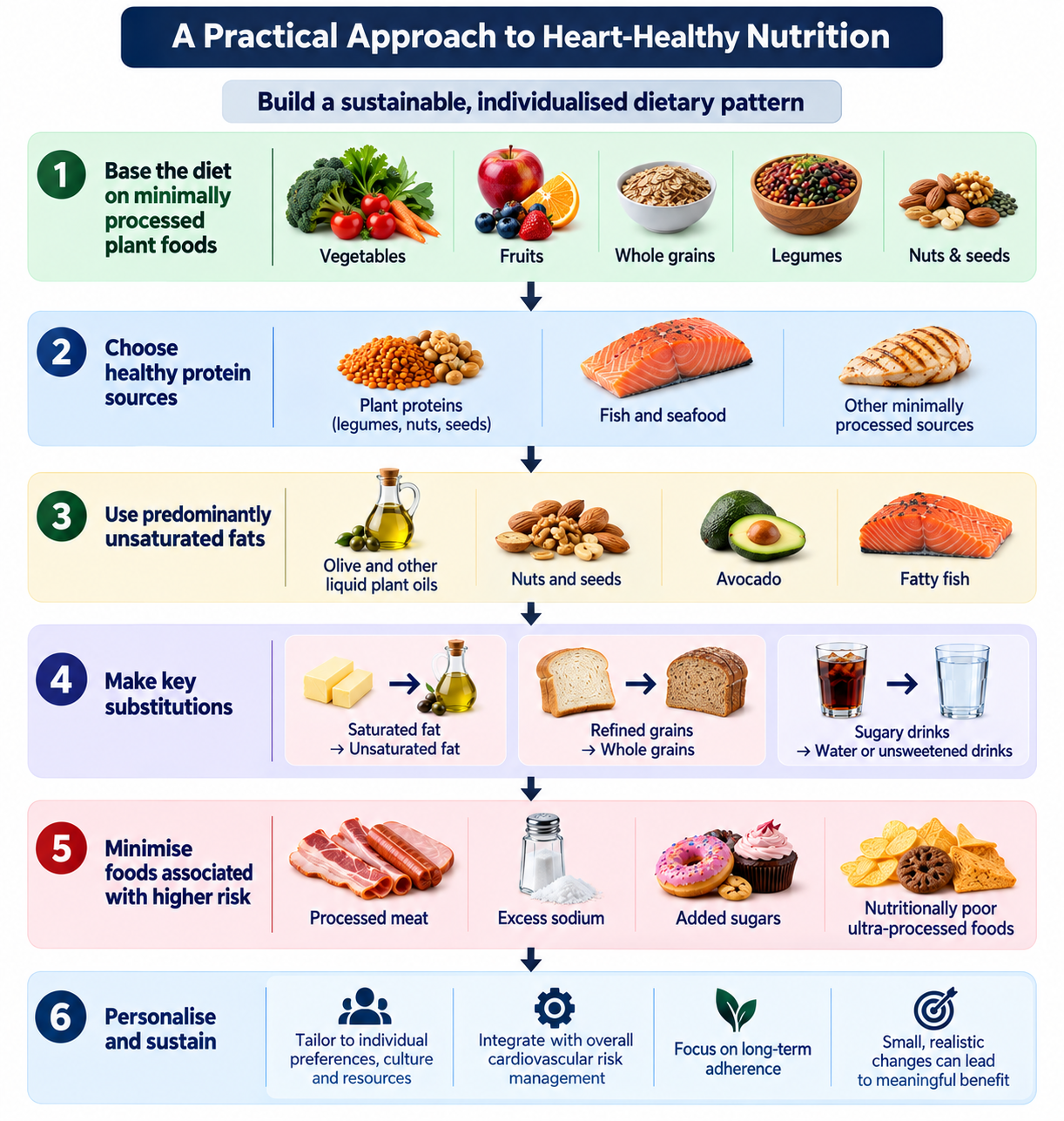
Build the diet around Vegetables + fruits + whole grains + legumes + nuts and seeds
↓
Choose healthy protein sources Plant proteins → fish/seafood → other minimally processed sources
↓
Choose predominantly unsaturated fats Liquid plant oils + nuts + seeds + fish
↓
Make substitutions rather than simply restricting foods Saturated fat → unsaturated fat Refined grains → whole grains Sugar-sweetened drinks → water or unsweetened beverages
↓
Minimise Processed meats + excess sodium + added sugars + nutritionally poor ultra-processed foods
Fat: replacement matters
The statement strongly supports replacing saturated fats with unsaturated fats.
Replacing butter, animal fats and tropical oils rich in saturated fat with liquid plant oils, nuts, seeds and fish lowers LDL cholesterol and cardiovascular risk. Importantly, replacing saturated fat with refined starches or added sugars does not provide the same cardiovascular benefit.
This means that advice such as “eat less fat” is too simplistic. A more useful clinical message is:
Replace saturated fat with unsaturated fat.
Carbohydrate: prioritise quality
Whole grains, legumes, vegetables and fruit should form the principal carbohydrate sources.
Whole grains and fibre-rich foods are consistently associated with lower risks of obesity, diabetes and cardiovascular disease. In contrast, added sugars—particularly sugar-sweetened beverages—are associated with greater cardiometabolic risk.
For patients asking whether they should “cut carbs”, the better question is often which carbohydrates should be replaced?
Whole grains and minimally processed plant foods should generally replace refined grains, sugary foods and sugar-sweetened drinks.
Protein: source matters
Protein quantity alone does not determine cardiovascular benefit.
The statement favours greater use of plant proteins such as legumes, nuts and seeds, alongside fish and seafood. Higher intake of red and particularly processed meats is associated with less favourable cardiovascular outcomes, whereas higher plant-protein intake is associated with lower cardiovascular and all-cause mortality.
The practical message is therefore not necessarily “high protein versus low protein”, but rather:
Choose better protein sources.
Sodium, potassium and fibre: three actionable targets
| Nutrient | Practical message |
|---|---|
| Sodium | Aim for <2,300 mg/day and ideally <1,500 mg/day for most adults |
| Potassium | Increase through fruits, vegetables, legumes and other potassium-rich foods when appropriate |
| Fibre | Aim for at least 25 g/day, primarily from whole foods |
Lower sodium diets can reduce systolic blood pressure substantially. Potassium-rich foods can also support blood-pressure reduction, while potassium-enriched salt substitutes may be useful in selected patients. However, caution is required in advanced CKD, hyperkalaemia risk and in some patients taking potassium-sparing therapies.
Fibre-rich diets improve satiety and are associated with better blood pressure, glycaemic control and lipid profiles.
Which dietary pattern is best?
Mediterranean, DASH and healthy plant-forward dietary patterns differ in some details, but they share the same basic structure:
| Emphasise | Limit |
|---|---|
| Vegetables | Red and processed meat |
| Fruits | Refined grains |
| Whole grains | Sugar-sweetened foods and drinks |
| Legumes | Excess sodium |
| Nuts and seeds | Nutritionally poor ultra-processed foods |
| Unsaturated fats | Excess saturated fat |
Among these patterns, the Mediterranean diet has particularly strong randomised-trial evidence. Both PREDIMED in primary prevention and CORDIOPREV in secondary prevention demonstrated fewer major cardiovascular events with Mediterranean dietary patterns compared with low-fat control diets.
The practical implication is that clinicians do not necessarily need to prescribe one rigid named diet. Instead, patients can adopt the common components of these cardioprotective patterns in ways that fit their culture, preferences and resources.
Ultra-processed foods: avoid oversimplification
The ACC supports reducing ultra-processed foods, particularly:
Sugar-sweetened beverages, processed meats, foods rich in refined starches, added sugars, sodium and unhealthy fats.
However, the statement also makes an important distinction: not every food classified as ultra-processed has the same cardiovascular effect.
Some wholegrain breads, yoghurts and breakfast cereals may still have favourable nutritional profiles. Therefore, both processing and overall nutritional quality should be considered rather than relying only on the label “ultra-processed”.
Low-carbohydrate diets: useful in selected patients
Low-carbohydrate dietary patterns can improve glycaemic control in people with diabetes and may facilitate weight loss.
But their cardiovascular impact depends heavily on what replaces carbohydrate.
A low-carbohydrate pattern rich in plant proteins and unsaturated fats is very different from one dominated by saturated-fat-rich animal foods. Very low-carbohydrate or ketogenic diets may increase LDL-C, particularly when saturated-fat intake is high.
If choosing a low-carbohydrate strategy
Reduce carbohydrate
↓
Replace with
Plant protein + nuts + seeds + unsaturated fats
↓
Avoid making saturated-fat-rich animal foods the main replacement
Intermittent fasting: an option, not a cardiovascular breakthrough
Intermittent fasting can reduce body weight and improve short-term metabolic parameters in some patients.
However, when compared with continuous energy restriction, differences in weight loss are generally modest, and evidence for long-term cardiovascular benefit remains limited.
It can therefore be considered a practical method of calorie restriction for selected patients rather than a uniquely cardioprotective dietary strategy.
Nutrition in the GLP-1 era
The increasing use of GLP-1 receptor agonists introduces a new nutritional challenge.
These therapies can deliver substantial weight loss and cardiovascular benefit, but reduced food intake can also increase the risk of inadequate protein and micronutrient intake and contribute to loss of lean body mass.
The ACC statement therefore emphasises maintaining dietary quality during treatment.
Practical nutrition during GLP-1 therapy
| Priority | Practical target |
|---|---|
| Protein | Approximately 60–75 g/day, with individualisation |
| Fibre | ≥21 g/day in women; ≥30 g/day in men |
| Fluid | Approximately 2–3 L/day where appropriate |
| Food quality | Nutrient-dense foods, vitamins and minerals |
| Muscle preservation | Adequate protein + resistance exercise |
Nutrition counselling can also help manage gastrointestinal adverse effects and maintain overall nutritional status during weight loss.
Coffee, alcohol, omega-3 and sweeteners
Coffee and tea
Moderate intake of filtered coffee or tea—approximately 2–5 cups per day and up to around 400 mg caffeine daily—appears safe for most adults.
Alcohol
Patients who do not drink alcohol should not start drinking for cardiovascular benefit. Observational associations between low-to-moderate alcohol intake and lower coronary risk do not establish causality, while alcohol can increase blood pressure, atrial fibrillation risk and several cancers.
Omega-3
Fish should generally be preferred as part of a healthy dietary pattern. Routine omega-3 supplementation is not recommended for primary prevention of cardiovascular disease.
Non-nutritive sweeteners
Long-term cardiometabolic effects remain uncertain. When possible, water and other unsweetened beverages should remain the preferred drinks.
A notable disagreement with the 2025–2030 Dietary Guidelines for Americans
The ACC statement agrees with the newer Dietary Guidelines for Americans on prioritising whole and minimally processed foods and reducing ultra-processed foods, particularly sugar-sweetened beverages.
However, it questions the stronger emphasis on higher protein targets, full-fat dairy and animal-fat sources such as butter and beef tallow. The ACC argues that these recommendations are not fully aligned with the broader cardiovascular evidence favouring replacement of saturated fat with unsaturated fat, particularly from plant sources.
What should clinicians actually tell patients?
A practical conversation can be reduced to four messages:
- Eat more: vegetables, fruits, whole grains, legumes, nuts, seeds and fish.
- Replace: saturated fat with unsaturated fat; refined grains with whole grains; sugary drinks with water or unsweetened beverages.
- Eat less: processed meat, excess sodium, added sugar and nutritionally poor ultra-processed foods.
- Think dietary pattern: sustainable, minimally processed and plant-forward rather than chasing individual “superfoods” or macronutrient percentages.
The statement's overall conclusion is that healthy dietary patterns remain central to cardiovascular prevention and management across the cardiovascular-kidney-metabolic continuum.
Bottom line
The 2026 ACC statement moves cardiovascular nutrition away from rigid nutrient counting and towards food quality, substitution and sustainable dietary patterns.
For clinical practice, the most useful message is straightforward:
Build the diet around minimally processed plant foods, replace saturated fats with unsaturated fats, choose high-quality carbohydrate and protein sources, reduce sodium and unhealthy ultra-processed foods, and tailor the dietary pattern to the individual patient.
Nutrition is not an optional addition to cardiovascular therapy. It remains one of its foundations.
Source
Hu FB, Beleslin B, Blaha MJ, Kris-Etherton PM, Seligman HK, Williams KA Sr. Food and Health: Nutrition for Prevention and Management of Cardiovascular Disease: 2026 ACC Scientific Statement. Journal of the American College of Cardiology. 2026. doi:10.1016/j.jacc.2026.08.025.