
Why does Lp(a) matter?
Lipoprotein(a), or Lp(a), is an apolipoprotein B-containing lipoprotein that resembles LDL but also carries apolipoprotein(a). Its concentration is largely determined genetically and tends to remain relatively stable throughout life.
Elevated Lp(a) is an independent and causal risk factor for atherosclerotic cardiovascular disease (ASCVD) and is also associated with calcific aortic valve stenosis.
Unlike LDL-C, Lp(a) is not included in a standard lipid profile. A patient can therefore have apparently satisfactory conventional lipid results while still carrying substantial inherited cardiovascular risk from an elevated Lp(a).
Cardiovascular risk rises progressively as Lp(a) increases. The commonly used thresholds should therefore be interpreted as practical risk categories rather than rigid biological cut-offs.
Who should have Lp(a) measured?
Current guidance supports measuring Lp(a) at least once in all adults.
Universal testing can uncover an inherited cardiovascular risk factor that might otherwise remain undetected and may help refine the intensity of preventive management.
Testing is particularly informative when there is:
- premature ASCVD;
- a strong family history of premature cardiovascular disease;
- familial hypercholesterolaemia;
- premature aortic stenosis; or
- cardiovascular disease that appears disproportionate to conventional risk factors.
Because Lp(a) is predominantly genetically determined, a single measurement will often provide useful long-term information.
Algorithm 1 — Testing and repeat measurement
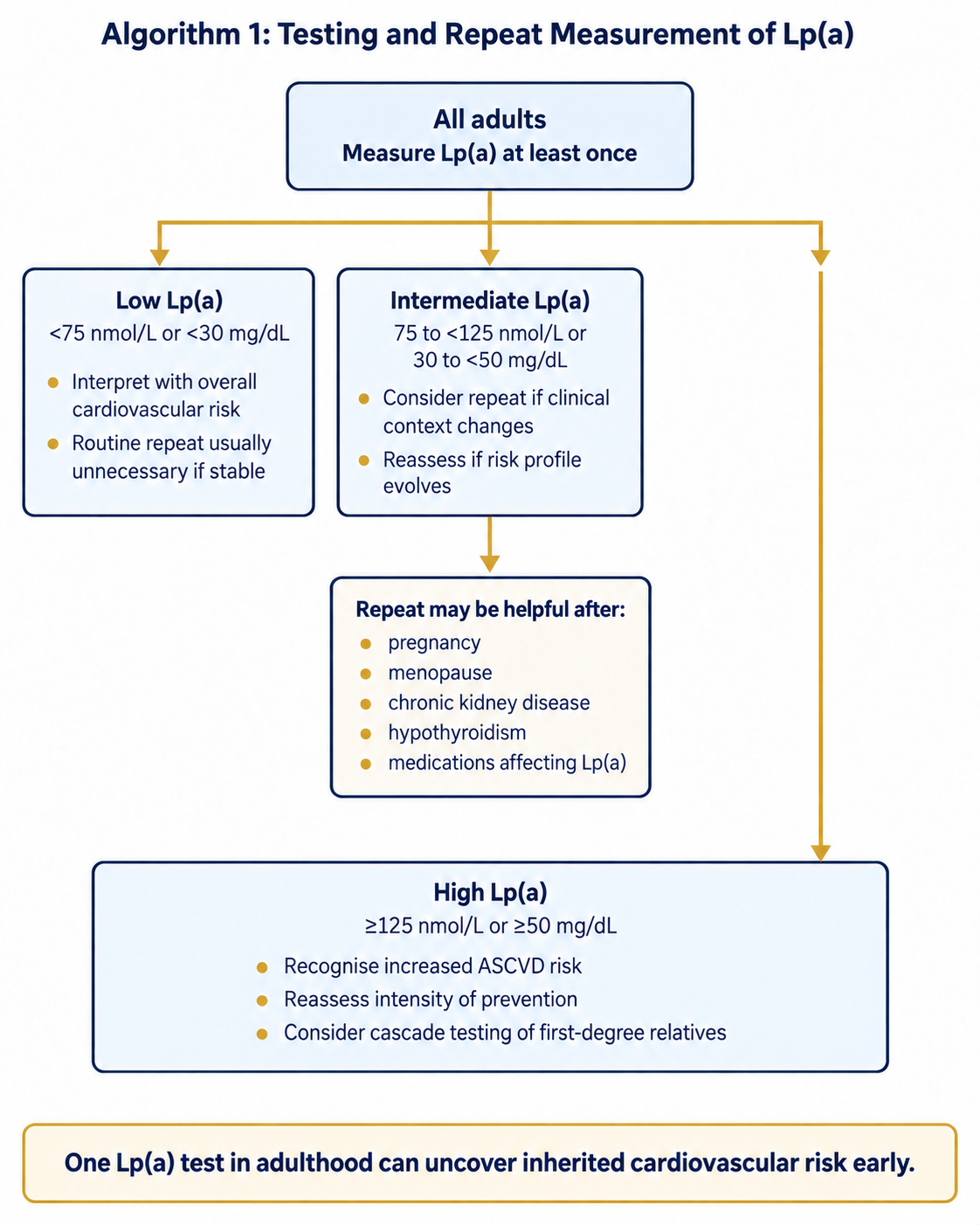
ALL ADULTS
↓ Measure Lp(a) at least once
If Lp(a) is low
<75 nmol/L or <30 mg/dL
→ Interpret alongside overall cardiovascular risk → Routine repeat testing is usually unnecessary if the clinical situation remains stable
If Lp(a) is intermediate
75 to <125 nmol/L or 30 to <50 mg/dL
→ Consider repeat measurement if the clinical context changes
Situations that may justify reassessment include:
- pregnancy;
- menopause;
- development of chronic kidney disease;
- hypothyroidism; or
- medications that may influence Lp(a).
If Lp(a) is high
≥125 nmol/L or ≥50 mg/dL
→ Recognise increased ASCVD risk → Reassess the intensity of cardiovascular prevention → Consider cascade testing of first-degree relatives
How should Lp(a) be interpreted?
The National Lipid Association uses three practical categories:
| Category | Lp(a), nmol/L | Lp(a), mg/dL |
|---|---|---|
| Low | <75 | <30 |
| Intermediate | ≥75 to <125 | ≥30 to <50 |
| High | ≥125 | ≥50 |
The NLA favours reporting Lp(a) in nmol/L.
An Lp(a) concentration of ≥125 nmol/L or ≥50 mg/dL should be regarded as an ASCVD risk-enhancing finding.
Importantly, the result should never be interpreted in isolation. Lp(a) should be considered alongside LDL-C, blood pressure, diabetes, smoking status, family history and whether ASCVD is already present.
Should relatives be tested?
Because Lp(a) levels are strongly genetically determined, elevated concentrations often cluster within families.
Cascade screening of first-degree relatives is particularly relevant when elevated Lp(a) occurs alongside:
- premature ASCVD;
- premature aortic stenosis; or
- familial hypercholesterolaemia.
Finding high Lp(a) in one patient may therefore provide an opportunity to identify cardiovascular risk earlier in parents, siblings or children.
What should be done when Lp(a) is elevated?
The main principle is simple:
Treat the patient's overall cardiovascular risk — not just the Lp(a) number.
Management should include appropriate attention to:
- LDL-C;
- blood pressure;
- diabetes;
- smoking;
- weight;
- physical activity; and
- other modifiable ASCVD risk factors.
Algorithm 2 — Managing elevated Lp(a)
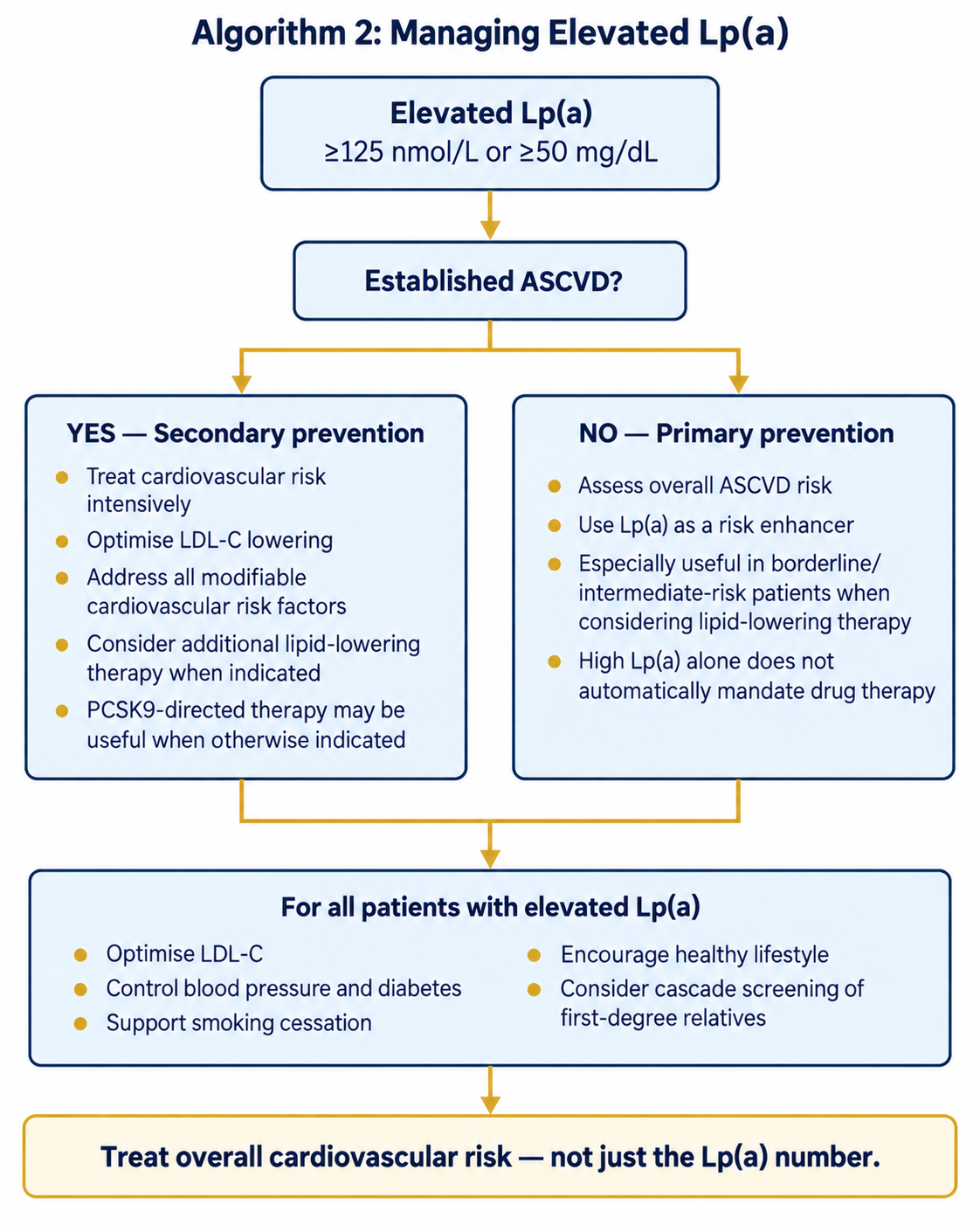
ELEVATED Lp(a) ≥125 nmol/L or ≥50 mg/dL
↓
Does the patient have established ASCVD?
YES — Secondary prevention
→ Treat cardiovascular risk intensively → Optimise LDL-C lowering → Address all modifiable cardiovascular risk factors → Consider whether additional lipid-lowering therapy is required → Consider PCSK9-directed therapy when otherwise indicated
NO — Primary prevention
→ Assess the patient's overall ASCVD risk
If borderline or intermediate risk
→ Use elevated Lp(a) as a risk enhancer when discussing initiation or intensification of lipid-lowering treatment
If otherwise low risk
→ High Lp(a) alone does not automatically establish a pharmacological treatment indication → Consider the total risk profile, family history and patient preferences
For all patients with elevated Lp(a)
→ Optimise LDL-C → Control blood pressure and diabetes → Support smoking cessation → Encourage a healthy lifestyle → Consider cascade screening of first-degree relatives
Can lifestyle modification lower Lp(a)?
Lifestyle measures have major cardiovascular benefits, but they generally do not produce substantial reductions in genetically determined Lp(a).
This is important when counselling patients.
Healthy diet, regular exercise, weight management and smoking cessation remain essential because they reduce overall ASCVD risk, even if Lp(a) itself remains unchanged.
What do current treatments do to Lp(a)?
| Therapy | Effect on Lp(a) | Practical message |
|---|---|---|
| Statins | May slightly increase | Continue when indicated; cardiovascular benefit outweighs the small rise |
| PCSK9 inhibitors | ↓ approximately 20–30% | Useful when additional LDL-C lowering is required |
| Ezetimibe | No significant effect | Use for LDL-C lowering when indicated |
| Bempedoic acid | No significant effect | Use for LDL-C lowering when indicated |
| Lifestyle modification | No consistent reduction | Essential for overall cardiovascular prevention |
| Niacin | ↓ approximately 20–30% | Not recommended specifically for Lp(a) lowering |
| Lipoprotein apheresis | Major reduction | Reserved for selected eligible high-risk patients |
Statins
Statins do not lower Lp(a) and may produce a small increase in some patients.
This is not a reason to avoid or discontinue statin therapy. Their established ability to reduce ASCVD events remains far more important.
PCSK9-directed therapies
PCSK9 inhibitors can reduce Lp(a) by approximately 20–30% while also producing substantial LDL-C lowering.
They are not approved specifically for elevated Lp(a), but they may be particularly useful when a high-risk patient requires further LDL-C reduction.
Niacin
Niacin can lower Lp(a), but cardiovascular outcome trials have not demonstrated sufficient clinical benefit to justify using it specifically for this purpose.
It is therefore not recommended simply to reduce the Lp(a) concentration.
Lipoprotein apheresis
Lipoprotein apheresis can substantially reduce Lp(a), but it is an intensive treatment restricted to selected high-risk patients meeting specific eligibility criteria.
What about aspirin?
Aspirin does not lower Lp(a).
Some studies have suggested that individuals with elevated Lp(a) may derive greater cardiovascular benefit from aspirin in primary prevention than those with lower levels.
However, current evidence is insufficient to recommend routine aspirin simply because Lp(a) is elevated. Any potential cardiovascular benefit must still be weighed against bleeding risk.
What targeted Lp(a)-lowering therapies are emerging?
Several therapies are capable of reducing Lp(a) far more substantially than currently available lipid-lowering drugs.
Important agents in development include:
| Therapy | Approach | Approximate Lp(a) reduction reported |
|---|---|---|
| Pelacarsen | Antisense oligonucleotide | ~72–80% |
| Olpasiran | siRNA | ~95% |
| Lepodisiran | siRNA | ~94% |
| Muvalaplin | Oral small molecule | Up to ~86% for intact Lp(a) |
These reductions are impressive, but the clinically important question is whether lowering Lp(a) translates into fewer myocardial infarctions, strokes and other cardiovascular events.
The review notes that a September 2026 press release reported that the pelacarsen Lp(a)HORIZON trial did not meet its primary cardiovascular endpoint, with full results still awaited when the article was written.
This reinforces an important principle:
Lowering a biomarker substantially does not automatically mean that cardiovascular outcomes will improve.
When should specialist input be considered?
Lipid-specialist assessment may be particularly useful when Lp(a) is very high, approximately ≥200 nmol/L or ≥75 mg/dL, especially when accompanied by:
- established ASCVD;
- familial hypercholesterolaemia;
- complex dyslipidaemia;
- recurrent cardiovascular events; or
- uncertainty about the appropriate intensity of lipid-lowering treatment.
Clinical takeaway
Lp(a) is becoming an important component of routine cardiovascular risk assessment.
For most adults, measuring it once can identify a major inherited source of cardiovascular risk. An Lp(a) concentration of ≥125 nmol/L or ≥50 mg/dL should prompt careful reassessment of the patient's overall ASCVD risk and the intensity of preventive management.
Until targeted Lp(a)-lowering therapies are proven to improve cardiovascular outcomes and become routinely available, the practical priority remains optimising LDL-C and aggressively addressing the patient's overall modifiable cardiovascular risk.
Full reference
Koschinsky ML, Ballantyne CM. Lipoprotein(a) Management Simplified: The National Lipid Association Lipid Simplified Series. Journal of Clinical Lipidology. 2026. doi:10.1016/j.jacl.2026.09.013.