
EASL–EASD–EASO Guidance in Practice
The management of metabolic dysfunction-associated steatohepatitis (MASH) has entered a new therapeutic era. Clinicians now have two MASH-targeted pharmacological options—resmetirom and semaglutide 2.4 mg weekly—and treatment decisions increasingly depend on who should be treated, which agent best fits the patient, and how response should be monitored.
The 2026 joint EASL–EASD–EASO guidance provides a practical framework for treating adults with MASH while maintaining lifestyle intervention and optimisation of cardiometabolic risk.
Who should receive MASH-targeted pharmacotherapy?
The principal treatment population is:
Adults with non-cirrhotic MASH and significant or advanced fibrosis, corresponding to F2–F3.
Treatment eligibility may be established using appropriate non-invasive tests (NITs) or liver biopsy.
Pharmacotherapy should always be used in addition to structured lifestyle intervention, not as a replacement for it.
Patients with F0–F1 fibrosis are not currently the main target population for MASH-specific treatment, while patients with cirrhosis require a different approach.
Use non-invasive tests to identify treatment-eligible fibrosis
Routine liver biopsy is no longer required for most patients.
Suggested NIT ranges compatible with treatment-eligible fibrosis include:
| Test | Suggested range |
|---|---|
| VCTE | 10–20 kPa |
| MRE | 3.1–5.0 kPa |
| ELF | 9.8–11.3 |
An elevated VCTE should be confirmed by repeat testing or another fibrosis NIT. ELF should ideally also be supported by another test.
Two concordant fibrosis NITs increase confidence that clinically relevant fibrosis is present.
Role of FIB-4
FIB-4 remains useful for initial risk stratification, particularly in primary care, diabetes and obesity settings.
However, it should not be used alone to determine eligibility for MASH pharmacotherapy. Patients with indeterminate or high-risk results should undergo more specific fibrosis assessment with VCTE, ELF or MRE.
When is liver biopsy still useful?
Biopsy may be considered when:
- NITs are discordant or borderline
- another liver disease is suspected
- diagnostic uncertainty remains
- histology is likely to change management
Practical Algorithm: Identifying and Treating MASH
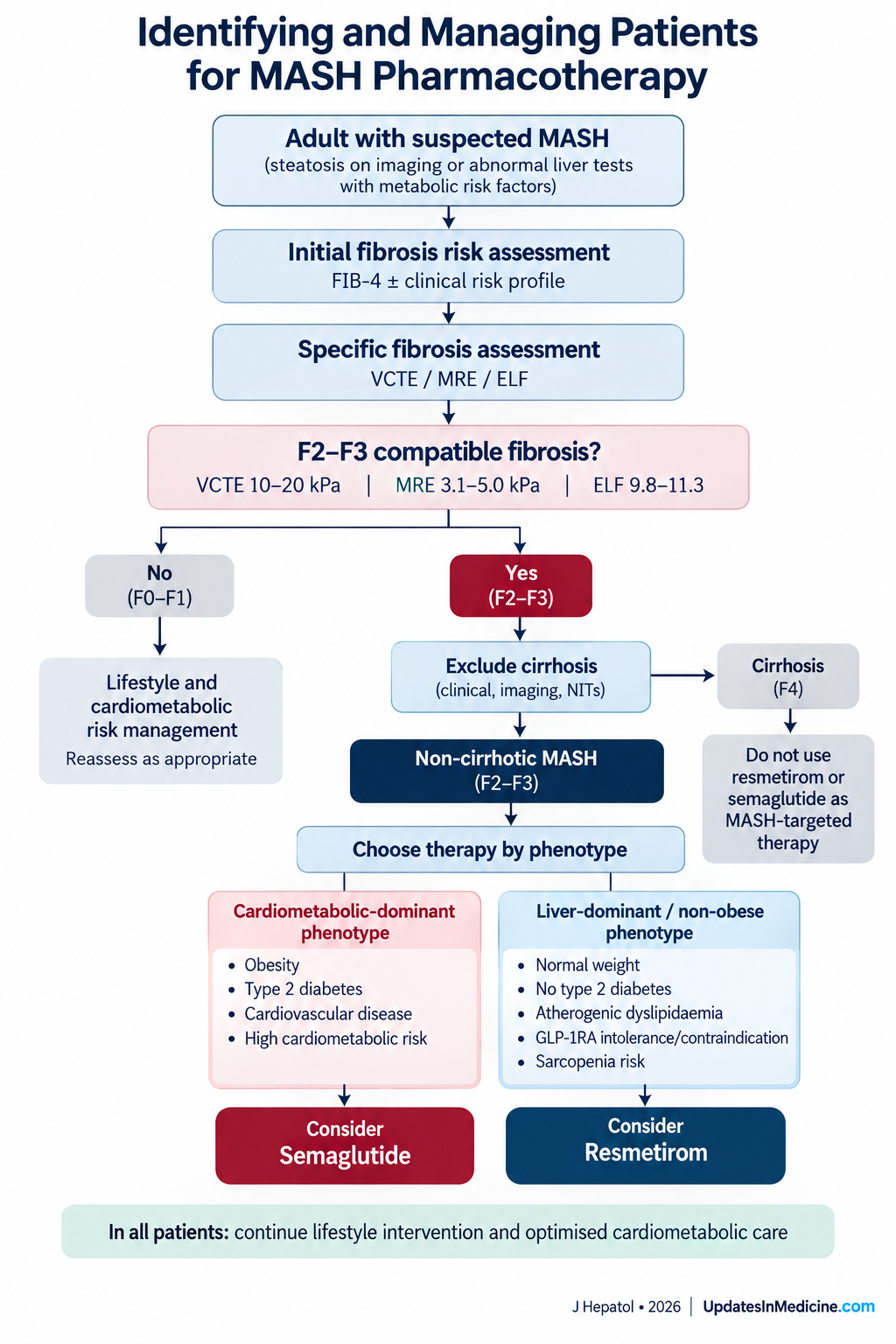
Suspected MASH ↓ Initial risk stratification with FIB-4 ↓ Specific fibrosis assessment: VCTE / MRE / ELF ↓
F2–F3-compatible fibrosis?
No → Continue lifestyle and cardiometabolic risk management → Reassess according to risk
Yes ↓ Exclude cirrhosis ↓
Non-cirrhotic MASH with F2–F3 fibrosis
↓ Choose therapy according to phenotype
Cardiometabolic-dominant phenotype Obesity • T2D • cardiovascular disease • CKD → Consider semaglutide
Liver-dominant / non-obese phenotype Normal weight • already on GLP-1RA • GLP-1RA intolerance • atherogenic dyslipidaemia • sarcopenia risk → Consider resmetirom
In all patients: continue lifestyle intervention and optimise cardiometabolic care.
Resmetirom or semaglutide?
There is no head-to-head randomised trial showing that one agent is universally superior.
The guidance therefore recommends individualised treatment selection according to clinical phenotype, comorbidities, risks, administration route and patient preference.
When semaglutide may be prioritised
Semaglutide may be particularly attractive in patients with:
- obesity
- overweight with weight-related comorbidities
- type 2 diabetes outside glycaemic targets
- established cardiovascular disease
- high cardiovascular risk
- chronic kidney disease with obesity and/or T2D
Its major advantage is the broader cardiometabolic effect, including weight reduction and improved glycaemic control.
When resmetirom may be prioritised
Resmetirom may be favoured in patients with:
- normal weight or absence of obesity
- no type 2 diabetes
- established GLP-1RA therapy for another indication
- GLP-1RA intolerance
- prominent atherogenic dyslipidaemia
- preference for oral therapy
- presence or high risk of sarcopenia
Resmetirom also improves several atherogenic lipid parameters, including LDL cholesterol, triglycerides, ApoB and lipoprotein(a).
Baseline assessment before treatment
Before starting either therapy, confirm:
Liver status
- F2–F3 fibrosis
- absence of cirrhosis
- no competing liver disease
Cardiometabolic status
- T2D and glycaemic control
- body weight and adiposity
- lipid profile
- blood pressure
- cardiovascular disease
- CKD
Resmetirom-specific considerations
- thyroid function
- relevant drug interactions
- statin therapy
- clopidogrel use
- gallbladder disease
Semaglutide-specific considerations
- pancreatitis history
- gallbladder disease
- severe GI disease or gastroparesis
- kidney function
- diabetic eye disease
- MEN2 / thyroid C-cell tumour risk
- nutritional status
- sarcopenia risk
Semaglutide titration
For MASH treatment, semaglutide is gradually up-titrated:
| Treatment period | Weekly dose |
|---|---|
| Weeks 1–4 | 0.25 mg |
| Weeks 5–8 | 0.5 mg |
| Weeks 9–12 | 1.0 mg |
| Weeks 13–16 | 1.7 mg |
| After week 16 | 2.4 mg |
Dose escalation should be guided by tolerability.
Monitoring resmetirom
During the first year, review at approximately:
3 months → 6 months → 12 months
Monitor:
- adverse effects and tolerability
- liver blood tests
- fibrosis NITs
- cardiometabolic status
Routine repeated thyroid testing is mainly required in patients with pre-existing thyroid disease or those receiving thyroid hormone replacement.
Monitoring semaglutide
During dose escalation and follow-up, assess:
- GI adverse effects
- body weight
- glycaemia in T2D
- nutritional intake
- muscle strength and muscle mass
- sarcopenia risk
This is particularly important when weight loss is rapid or substantial.
How should hepatic response be assessed?
Serial NITs should be used to assess response.
Potential supportive response signals include:
| Test | Potential response signal |
|---|---|
| VCTE | ≥30% relative reduction |
| MRE | ≥20% relative reduction |
| MRI-PDFF | ≥30% relative reduction |
| ELF | ≥0.5 absolute reduction |
| ALT | ≥17 U/L absolute reduction |
These are supportive markers, not fully validated stand-alone response biomarkers.
What if fibrosis remains stable?
Stable fibrosis does not automatically mean treatment failure.
Treatment may be continued when disease remains stable after approximately:
- 12 months with resmetirom
- 18 months with semaglutide
At the same time, clinicians should optimise lifestyle, weight, glycaemic control, alcohol exposure and other cardiometabolic risk factors.
What if fibrosis worsens?
Resmetirom
If fibrosis worsens after about 12 months, treatment discontinuation should be considered.
Semaglutide
If fibrosis worsens after about 18 months, an alternative MASH-targeted strategy should be considered.
Semaglutide may still be continued when there are important ongoing weight, glycaemic, cardiovascular or renal benefits.
When should treatment be stopped?
Resmetirom
Interrupt or discontinue for:
- suspected hepatotoxicity
- acute gallbladder-related adverse events until resolved
Semaglutide
Discontinue for serious events such as:
- acute pancreatitis
- dehydration-related acute kidney injury
- intestinal obstruction
- severe gastroparesis
- gallbladder disease
- thyroid C-cell tumour
What about cirrhosis?
Neither resmetirom nor semaglutide should currently be used specifically as MASH-targeted therapy in cirrhosis.
Semaglutide may still be used in compensated cirrhosis for established indications such as:
- type 2 diabetes
- chronic weight management
This should be distinguished from using semaglutide specifically to treat cirrhotic MASH.
Should resmetirom and semaglutide be combined?
Routine initiation of both agents together as first-line MASH-targeted therapy is not currently recommended.
However, existing cardiometabolic medications should generally continue.
In patients already receiving a GLP-1RA who remain eligible for MASH pharmacotherapy, possible strategies include:
- switching to semaglutide 2.4 mg weekly, or
- adding resmetirom
What remains uncertain?
Both therapies have demonstrated meaningful histological benefit, but the most important long-term question remains unanswered:
Do they reduce major adverse liver outcomes?
Ongoing trials are evaluating whether treatment reduces:
- progression to cirrhosis
- hepatic decompensation
- liver transplantation
- liver-related mortality
These outcomes will ultimately determine the long-term clinical impact of MASH pharmacotherapy.
What this means in clinical practice
The 2026 guidance shifts MASH care towards a more practical, phenotype-based treatment model:
- Identify non-cirrhotic F2–F3 disease
- Use NITs rather than routine biopsy
- Select therapy according to the patient's hepatic and cardiometabolic phenotype
- Consider semaglutide when obesity, T2D, cardiovascular disease or CKD dominate
- Consider resmetirom when liver-directed treatment, oral therapy, dyslipidaemia or sarcopenia risk are more important
- Continue lifestyle intervention throughout treatment
- Monitor fibrosis, safety and tolerability
- With semaglutide, actively monitor nutrition and muscle health
- Do not routinely use first-line combination therapy
- Recognise that long-term liver outcome benefits are still being established
Bottom line
MASH pharmacotherapy is now a realistic part of clinical practice for appropriately selected adults with non-cirrhotic F2–F3 fibrosis.
The key is not simply choosing a drug. It is identifying the right patient, matching therapy to the clinical phenotype, and monitoring response over time.
Original guideline
European Association for the Study of the Liver (EASL), European Association for the Study of Diabetes (EASD), European Association for the Study of Obesity (EASO). EASL–EASD–EASO guidance on the use of resmetirom and semaglutide as MASH-targeted therapy. *Journal of Hepatology*. 2026. doi:10.1016/j.jhep.2026.08.028. PIIS0168827826028771