
The 2026 British Society for Haematology guidance focuses on the laboratory diagnosis and monitoring of thrombotic thrombocytopenic purpura (TTP), particularly the appropriate use of ADAMTS13 testing.
The key principle is straightforward: suspected TTP is a medical emergency. ADAMTS13 testing is essential for confirmation, but treatment should not be delayed while waiting for the result when clinical suspicion is high.
When should TTP be suspected?
TTP should enter the differential when a patient has thrombocytopenia together with microangiopathic haemolytic anaemia (MAHA).
The platelet count is often markedly reduced, particularly <30 × 10⁹/L. The blood film may demonstrate schistocytes, although their absence does not exclude TTP. Other supportive findings include reticulocytosis, elevated LDH and low or undetectable haptoglobin. Routine coagulation parameters are usually normal.
Initial laboratory assessment
| Investigation | Finding supporting TTP |
|---|---|
| Full blood count | Thrombocytopenia, often <30 × 10⁹/L |
| Blood film | Schistocytes may be present |
| Reticulocyte count | Increased |
| LDH | Elevated |
| Haptoglobin | Low or undetectable |
| Coagulation tests | Usually normal |
| Renal and liver profile | Part of urgent initial assessment |
If a new patient has a platelet count below 30 × 10⁹/L, the guideline recommends examining the blood film as soon as possible, ideally within 60 minutes. Thrombocytopenia with morphological evidence of haemolysis should trigger rapid clinical escalation.
What to do when TTP is suspected
Once the combination of thrombocytopenia and MAHA raises significant concern for TTP, involve haematology urgently and obtain a pre-treatment sample for ADAMTS13 activity.
Where possible, the sample should be taken before plasma-based or other TTP-specific treatment because therapy can alter subsequent ADAMTS13 measurements. However, sampling must never delay treatment in a patient with high clinical suspicion.
For ADAMTS13 testing, the preferred sample is 3.2% sodium citrate (0.109 M) with an adequately filled tube. EDTA samples should not be used because EDTA may produce falsely low ADAMTS13 activity.
The practical diagnostic algorithm
This is the decision point where an algorithm is genuinely useful.
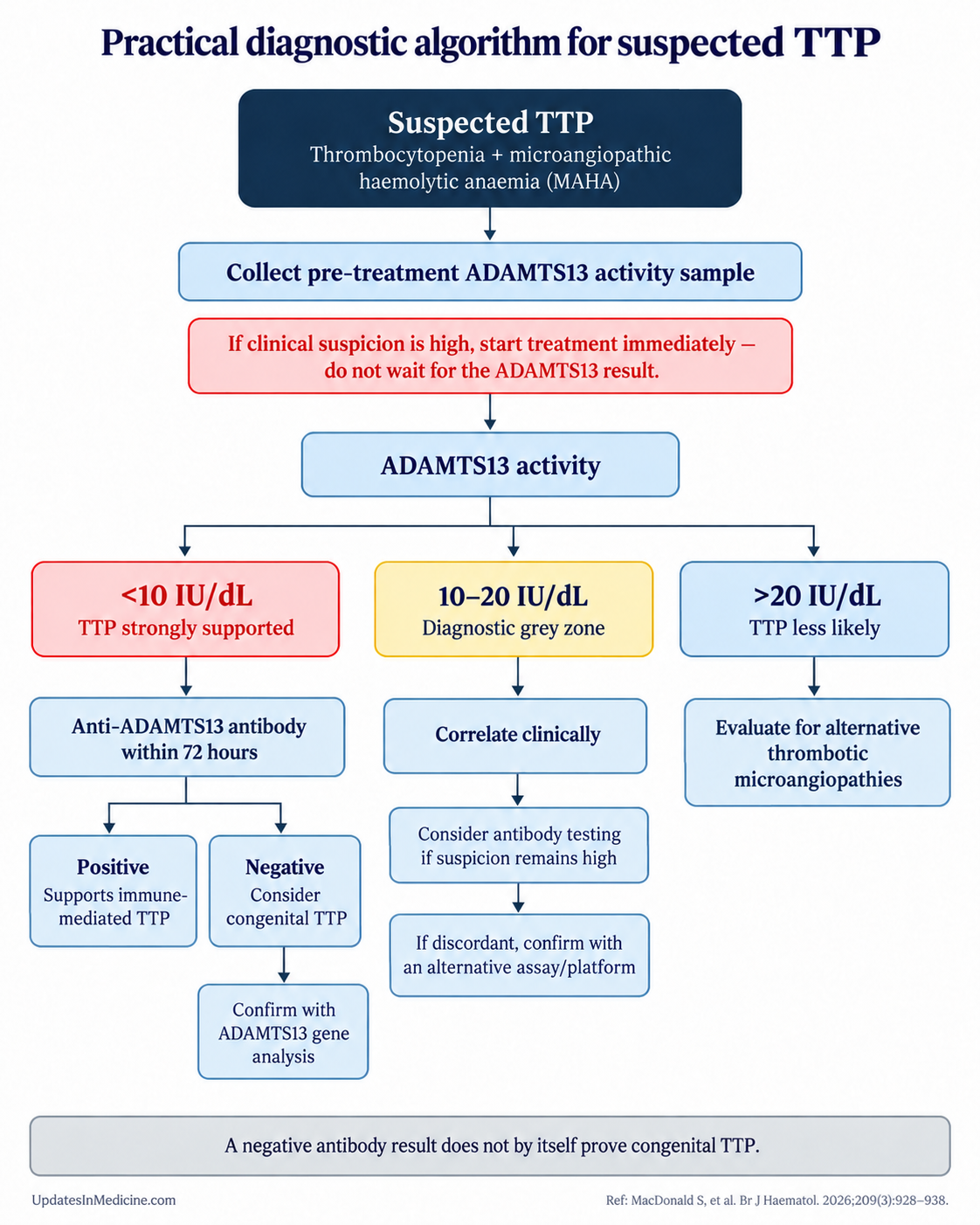
An ADAMTS13 activity of <10 IU/dL strongly supports TTP and should prompt anti-ADAMTS13 antibody testing within 72 hours. A result of 10–20 IU/dL is a diagnostic grey zone: reassess clinical probability, consider antibody testing if suspicion remains high, and consider an alternative assay or platform if the result does not fit the presentation. When activity is >20 IU/dL, TTP becomes less likely and alternative thrombotic microangiopathies should be evaluated. If a result remains discordant with a strongly suggestive presentation, discuss further testing with a specialist TTP laboratory.
This reflects the guideline's central diagnostic logic without turning every step of the work-up into an unnecessary flowchart.
How quickly should ADAMTS13 be available?
Urgent ADAMTS13 testing should be accessible either locally or through a regional TTP centre.
For suspected acute TTP, preliminary results should ideally be available:
| Method | Target preliminary result |
|---|---|
| Rapid ADAMTS13 assay | Within 1 hour of sample receipt |
| ELISA | Within 6 hours of sample receipt |
Rapid results can help confirm TTP sooner and can also prevent unnecessary exposure to plasma exchange and other TTP-directed therapies when another diagnosis is responsible for the thrombotic microangiopathy.
Interpreting ADAMTS13 activity correctly
An ADAMTS13 activity of <10 IU/dL remains the established threshold used to support the diagnosis of TTP.
The 10–20 IU/dL range requires particular caution. It should not simply be regarded as a negative test. The clinical presentation, pre-test probability and assay methodology all need to be considered.
Different ADAMTS13 platforms can produce different results around clinically important thresholds. If an activity result below 20 IU/dL appears inconsistent with the clinical picture, the guideline advises considering confirmation using an alternative analytical method or platform, rather than simply repeating the same assay.
Severe ADAMTS13 deficiency: immune or congenital TTP?
When ADAMTS13 activity is <10 IU/dL, anti-ADAMTS13 antibody testing is essential and should be performed within 72 hours of presentation.
Interpreting the antibody result
- Antibody detected: supports immune-mediated TTP.
- Antibody not detected: immune TTP is not automatically excluded. Consider congenital TTP where clinically appropriate; ADAMTS13 gene analysis is required to confirm congenital TTP.
This distinction is important because antibody-negative immune TTP can occur. The guideline reports that a small proportion of patients diagnosed with immune TTP had no detectable anti-ADAMTS13 antibodies at presentation, so a negative antibody result should not simply be equated with congenital disease.
For antibody detection, the guideline recommends ELISA in preference to non-standardised Bethesda-style inhibitor assays or mixing studies.
Do ADAMTS13 antigen and conformation assays have a routine role?
Not currently.
| Test | 2026 BSH position |
|---|---|
| ADAMTS13 antigen | Not recommended routinely; may be considered selectively |
| ADAMTS13 conformation assay | Not recommended for routine clinical use |
ADAMTS13 conformation testing is an interesting emerging area, particularly for relapse-risk assessment, but it remains a specialist adjunct rather than part of routine first-line diagnosis.
Monitoring after diagnosis
Serial ADAMTS13 activity measurement is central to surveillance after diagnosis in both immune-mediated and congenital TTP.
One practical recommendation is particularly important: use the same analytical method for an individual patient during follow-up whenever possible. Switching between platforms may introduce analytical variation that could be mistaken for a genuine change in disease activity.
If an unexpectedly low value is inconsistent with the patient's clinical status or previous trajectory, confirmation using a second platform may be useful.
Take-home points
- Think of TTP when thrombocytopenia and MAHA occur together.
- A markedly reduced platelet count, haemolysis and schistocytes should trigger urgent haematology review.
- Obtain a pre-treatment ADAMTS13 sample, but do not delay treatment in a patient with high clinical suspicion.
- ADAMTS13 <10 IU/dL strongly supports TTP.
- 10–20 IU/dL is a diagnostic grey zone, not an automatically negative result.
- When ADAMTS13 is <10 IU/dL, perform anti-ADAMTS13 antibody testing within 72 hours.
- A negative antibody result does not by itself prove congenital TTP; genetic testing is required for confirmation.
- Use the same ADAMTS13 assay platform during longitudinal monitoring whenever possible.
Reference
MacDonald S, Pitchford T, Singh D, Fretwell R, Jenkins PV, Lawrence C, et al. Diagnosis and monitoring of thrombotic thrombocytopenic purpura: Guidance for laboratories from the British Society for Haematology. British Journal of Haematology. 2026;209(3):928–938. doi:10.1111/bjh.70727.